

Measure your chest and length, compare those numbers to the size chart, and pick the size that gives you the amount of ease you want. Prioritize your chest measurement if the numbers don’t quite agree. Women usually size down one label for a closer fit. If you’re ordering for a group, request samples and test the fit before you commit to the full batch.
TL;DR:
- Measuring chest and length accurately is essential, with a half-inch buffer recommended due to variations in fabric and dye lot.
- Women often size down one label for a closer fit, while taller or broader individuals should prioritize length and check fit nuances like shoulder slope and sleeve placement.
- Ordering for groups requires recording individual measurements and preferred fit, with a focus on body length differences between youth and adult sizes.
- Fabric weight and shrinkage significantly affect the final fit, warranting pre-order testing by laundering samples before bulk purchasing.
- Choosing the correct size hinges on including desired ease and length preferences, especially for taller or slim-fit wearers, rather than relying solely on size charts.
Table of Contents
- How Do Unisex Shirts Fit? The Size Chart You Need
- How to Measure Your Chest, Shoulders, and Length
- What Unisex Sizing Actually Means Compared to Men’s and Women’s Cuts
- Why Youth XL and Adult Small Aren’t the Same Shirt
- How Fabric Weight and Shrinkage Change Your Final Fit
- How to Choose Between Two Sizes When You’re Not Sure
- What Shay’s Print Shop Brings to the Sizing Conversation
- The Sizing Advice Most Guides Get Backwards
- Get Bulk Unisex Tees Without the Sizing Guesswork
- Sources
How Do Unisex Shirts Fit? The Size Chart You Need
Unisex sizing runs on two numbers that actually matter: chest circumference and body length. Everything else on the label is a guess until you check those two measurements against what you’re actually ordering.
Here’s a standard unisex t-shirt chart. Chest is measured fully around the widest part of the shirt (not half, like some brands list), and length runs from the highest point of the shoulder down to the hem.
Treat these as a working baseline, not gospel. Retailers and brand guides consistently show that garment measurements shift from one label to the next, so checking the actual size chart on the product page beats trusting a size letter alone.
A shirt marked “Large” from one supplier might run a full inch narrower in the chest than another supplier’s Large. Give yourself a half-inch buffer either way when comparing your numbers to a chart, since printed garments can vary slightly by dye lot and fabric batch.
A few things drive that variation between brands:
- Different pattern blocks (some use a men’s cut, others grade a true neutral silhouette)
- Fabric weight, since heavier cotton behaves differently on the body than a lightweight blend
- Country of manufacture, which affects how consistently a factory grades between sizes
How to Measure Your Chest, Shoulders, and Length
You don’t need a tailor for this. A soft tape measure and five minutes will get you accurate numbers.
- Chest: Wrap the tape around the fullest part of your chest, under your arms, keeping the tape level and snug but not tight.
- Length: Measure from the highest point of your shoulder (next to your neck) straight down to where you want the hem to land.
- Shoulder width: Measure from the edge of one shoulder to the edge of the other, across your back.
- Sleeve length: Measure from the shoulder seam to where you want the sleeve to end.
If you’re measuring alone, lay a shirt you already own flat on a table and measure armpit to armpit, then double it for chest circumference. That trick works even without a second pair of hands.
For group orders, record every person’s numbers the same way: name, chest inches, length inches, preferred fit (close, standard, or oversized). Keep a half-inch tolerance in mind. Chests rarely land exactly on a chart line, and that’s fine.
What Unisex Sizing Actually Means Compared to Men’s and Women’s Cuts
“Unisex” almost always means a neutral or men’s-style block: straighter side seams, a boxier torso, and more room across the chest than a fitted women’s cut. That extra ease is intentional. It’s what lets one pattern work reasonably well across different body shapes.
The practical rules of thumb that follow from that construction:
- Women often size down one label from their usual fit for a closer silhouette in a unisex tee
- Men typically order their measured chest size straight off the chart without adjustment
- Taller or broader wearers should check length as closely as chest, since unisex blocks can run short in the body
That neutral cut isn’t just about the chest and hem. Shoulder slope and sleeve cap height rarely show up on a size chart, but they change how a shirt sits. A flatter shoulder slope common in unisex blocks can cause bunching at the armpit for narrow-shouldered wearers even when the chest measurement is spot on.
Pro Tip: When your shirt arrives, check three things before you decide the size is wrong: where the shoulder seam sits relative to your actual shoulder, whether the sleeve hem lands where you expect, and whether the extra chest room feels like ease or like you’re swimming in fabric.
Why Youth XL and Adult Small Aren’t the Same Shirt
This trips up more group orders than any other sizing mistake. A Youth XL and an Adult Small can list nearly identical chest measurements, but the shirts fit completely differently once you put them on.
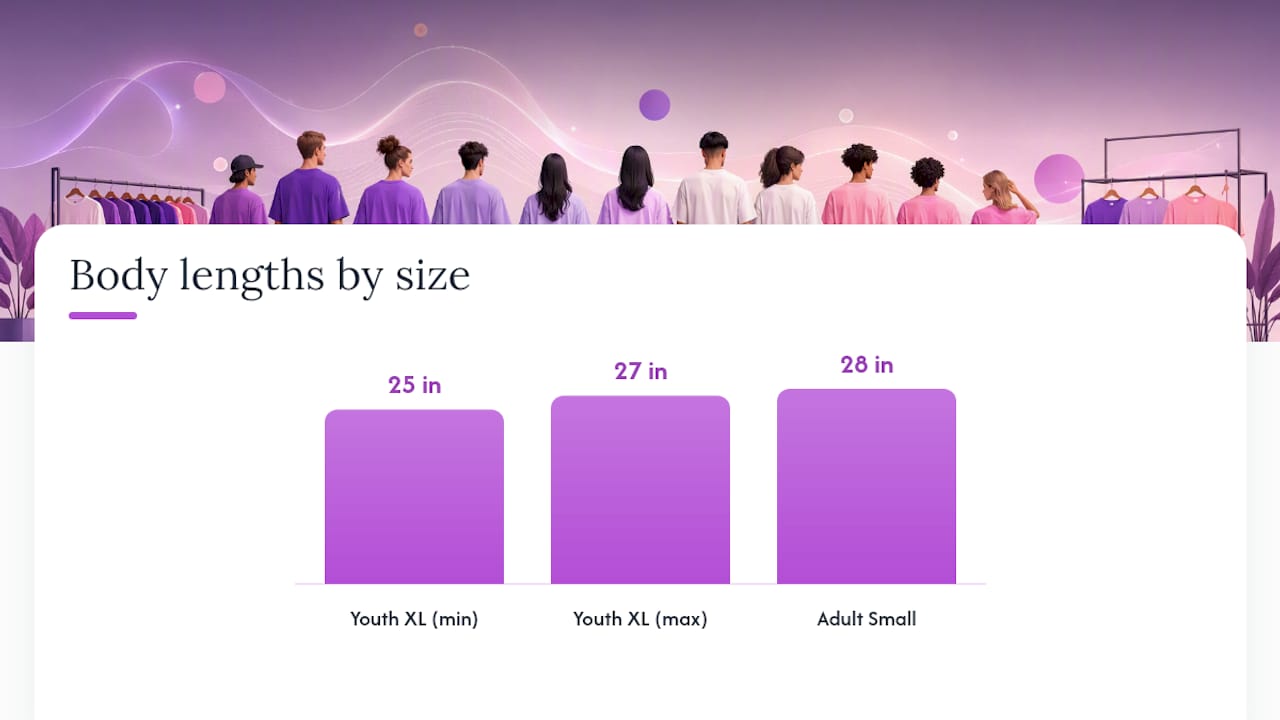
Adult Small typically runs 2 to 3 inches longer in body length than Youth XL, with wider shoulders and longer sleeves built into the adult pattern. An Adult Small usually measures around 28 inches in length, while Youth XL sits closer to 25 to 27 inches. That gap matters most for taller teens or petite adults who fall right between the two size systems.
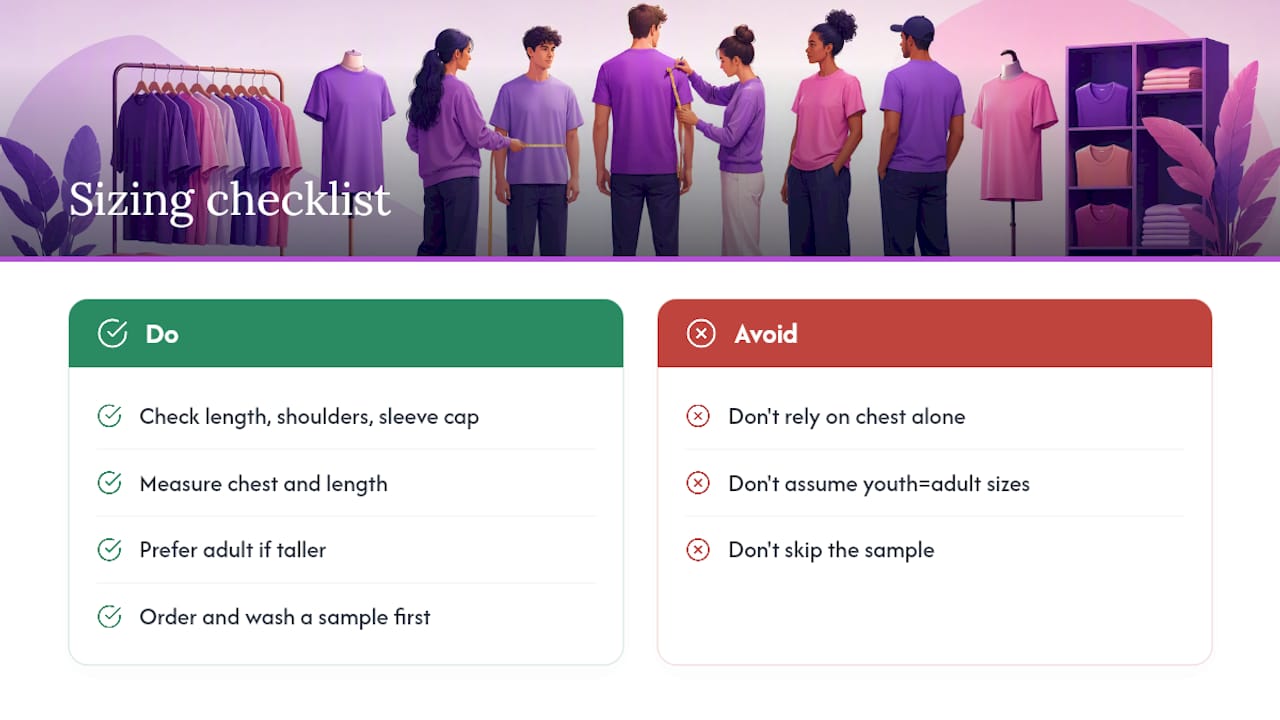
When ordering for mixed groups, follow this checklist:
- If chest matches but the wearer is over 5’4", default to adult sizing
- If sleeve length looks short in youth sizing on a taller frame, size up to adult
- For younger kids where torso length genuinely fits youth proportions, stay in youth sizing rather than forcing an oversized adult small
Shay’s Print Shop breaks this conversion down further in a dedicated guide on youth versus adult sizing for anyone converting sizes across a mixed-age group order.
How Fabric Weight and Shrinkage Change Your Final Fit
The size you order isn’t always the size you get after the first wash. Fabric content and weight decide how much a shirt moves once it leaves the factory.
100% cotton tends to shrink more than cotton-poly blends, which is why testing a sample before a bulk order matters more than most buyers realize. Heavier fabrics also hold their shape better, so a boxy or oversized cut stays boxy instead of collapsing after a few washes.
General weight guidance for common uses:
- Lightweight (around 4 oz): better drape, softer feel, more movement
- Midweight (roughly 4.3 to 5.3 oz): the balance point most unisex tees land on, and the recommended range for durability without stiffness
- Heavier (6 oz and up): structured, boxy, better for oversized or streetwear-style fits
Before committing to a full order, wash and dry one sample using the same method you’d use at home, then re-measure chest and length. That single test catches shrinkage problems before they show up on fifty shirts instead of one.
How to Choose Between Two Sizes When You’re Not Sure
Once you have your numbers, turn them into a decision instead of a guessing game.
- Add your desired ease to your chest measurement. Close fit means 0 to 1 inch of extra room, standard fit means 1 to 3 inches, and oversized means 3 inches or more. Find the chart size that matches.
- Check the length against your preference. If the length is off by more than 2 to 3 inches from what you want, that size is wrong for you even if the chest number looks right. Consider a different cut or size instead of forcing it.
- Build in room for shrinkage. If your sample shrank noticeably after one wash, size up or expect a tighter fit than the chart suggests.
For group orders, document each person’s chest measurement and their preferred hem location, not just a size letter. That extra column prevents the most common bulk-order complaint: shirts that technically match the chart but don’t match what people actually wanted. Shay’s Print Shop’s group sizing breakdown walks through typical size distributions for teams, reunions, and event orders if you need a starting ratio.
What Shay’s Print Shop Brings to the Sizing Conversation
Shay’s Print Shop builds its custom tees on 100% cotton with a bulk option of 10 shirts for $99, which makes sample testing realistic even for smaller groups instead of a luxury reserved for huge orders. Fast turnaround means you’re not waiting weeks to find out a size runs small.
If you’re planning logo placement alongside sizing, the logo placement guide covers exact print specs so your design lands correctly regardless of the size someone orders. And if your order sits below typical bulk minimums, the order minimums breakdown explains no-minimum options for smaller teams or families.
The recommended path: order a sample, wash it once using your normal routine, remeasure, and only then finalize sizes for the full group.
The Sizing Advice Most Guides Get Backwards
Most sizing content treats the chest measurement as the whole story. It isn’t. Length, shoulder slope, and sleeve cap height decide whether a shirt feels right on the body, and charts rarely show all three.
The youth-versus-adult confusion deserves more attention than it usually gets. Buyers see matching chest numbers between a Youth XL and an Adult Small and assume the shirts are interchangeable. They’re not, and that assumption ruins more group orders than a wrong size letter ever does. If someone on your list is taller than average or past their growth years, default to adult sizing even when the chest number tempts you toward youth.
The single highest-leverage habit in this entire process is the one people skip to save time: ordering a sample and washing it before committing to fifty or a hundred shirts. Chest and length numbers on a chart are a starting point, not a guarantee. Fabric behaves differently once it’s been through a dryer, and that’s the variable most sizing disasters trace back to. Measure first, test second, order last.
— Jon Will
Get Bulk Unisex Tees Without the Sizing Guesswork
Shay’s Print Shop takes the risk out of ordering unisex shirts in bulk. Instead of committing to fifty shirts based on a size chart alone, you get 10 custom 100% cotton tees for $99, which makes it affordable to order a small sample batch before finalizing sizes for your full event, team, or reunion.
Because every shirt starts from the same cotton blank, the fit stays consistent from sample to bulk order, so the shirt you test is the shirt you’ll receive at scale. If you’re outfitting a mixed group with kids and adults, the youth versus adult sizing guide walks through conversion before you place the order. Want another quick reference for measuring? Unikiff’s sizing guide covers the basics if you need a second opinion on your numbers.
Ready to test your fit before committing to the full group? Start your 10 shirt order and pair it with a custom tumbler if you’re putting together a full event bundle.
0 comments