

That’s the baseline used across most t-shirt size breakdown calculators, and it works because Medium, Large, and XL cover roughly 75% of adult body types in most mixed groups.
Here’s your one-line action step: multiply your total headcount by each percentage, round to whole shirts, and put any leftover fraction into Medium or Large. Those two sizes are your safety net when the math doesn’t divide evenly.
- XS: 5%
- S: 10%
- M: 25%
- L: 30%
- XL: 20%
- 2XL: 7%
- 3XL: 3%
Quick math check: For a 100-shirt order, that’s 5 XS, 10 S, 25 M, 30 L, 20 XL, 7 2XL, and 3 3XL. If your group skews male, older, or athletic, you’ll adjust these numbers, which we cover next.
Key Takeaways
Applying a percentage-based size distribution, adjusted for audience and buffered by group size, prevents the shortages and dead stock that plague guessed bulk orders.
| Point | Details |
|---|---|
| Start with the standard breakdown | Use 5% XS, 10% S, 25% M, 30% L, 20% XL, 7% 2XL, 3% 3XL as your mixed-adult baseline. |
| Adjust for your actual audience | Shift weight toward L/XL for athletic or men-focused groups, toward S/M for women-focused groups. |
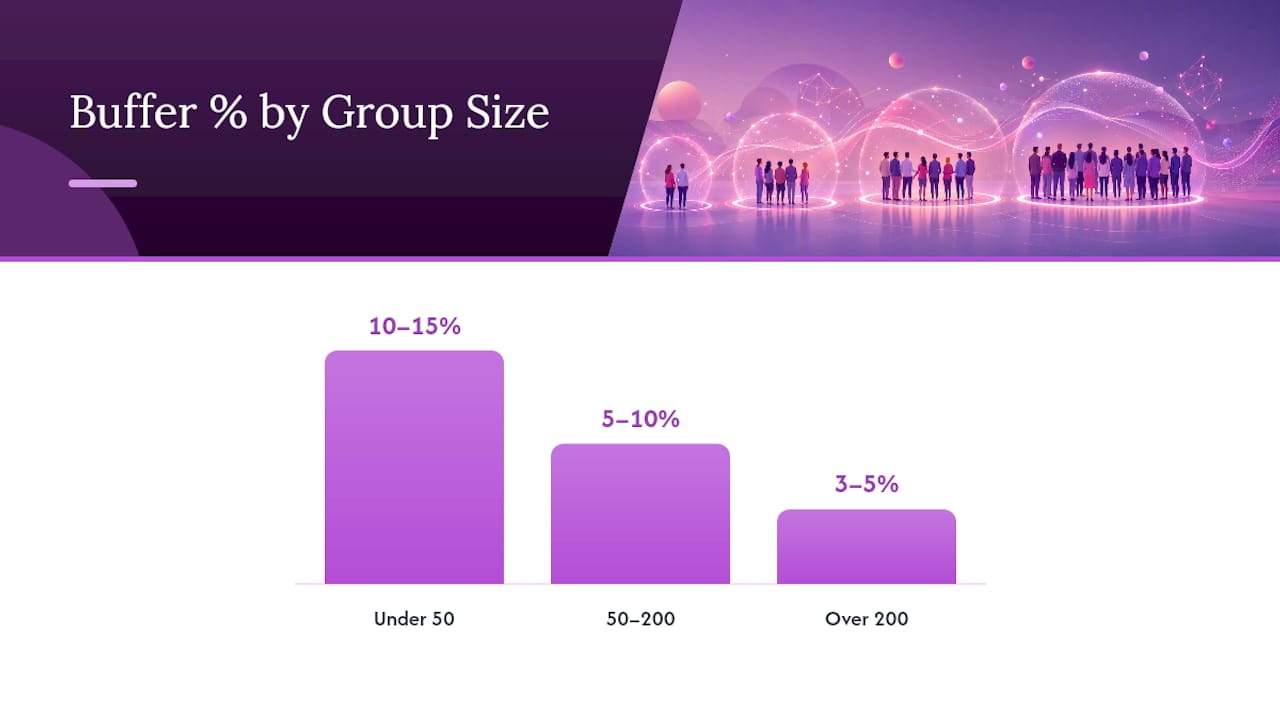
| Scale buffer to group size | Add 10 to 15% for groups under 50, 5 to 10% for mid-size groups, 3 to 5% for groups over 200. |
| Calculate styles separately | Run women’s cuts and youth sizes as independent calculations, then combine into one purchase order. |
| Work with Shay’s Print Shop | Get size-run consults built into your bulk quote, with DTF printing on 100% cotton and 10-for-$99 pricing. |
Table of Contents
- What Is a Standard Group Sizing Breakdown?
- How Do You Adjust the Breakdown for Different Audiences?
- How Many Extra Shirts Should You Order as a Buffer?
- Why You Can’t Combine Women’s Cuts and Unisex Sizes Into One Run
- What’s the Best Way to Collect Accurate Sizes From Your Group?
- What Are the Most Common Group Order Sizing Mistakes?
- How Shay’s Print Shop Applies This Breakdown in Real Orders
- What the Numbers Don’t Tell You About Group Orders
- Get Your Group Order Sized Right at Shay’s Print Shop
- Where to Verify These Numbers Yourself
- Sources
What Is a Standard Group Sizing Breakdown?
A group sizing breakdown is the percentage-based formula you use to convert a headcount into an exact shirt order across every size, from XS to 3XL. Instead of guessing or ordering an even split across sizes, you apply ratios based on real population sizing data, then multiply by your total order.
The table below is your starting point for any mixed adult group where you don’t have a full size survey back yet.
| Size | Percentage of Order | Example for 100 Shirts |
|---|---|---|
| XS | 5% | 5 |
| S | 10% | 10 |
| M | 25% | 25 |
| L | 30% | 30 |
| XL | 20% | 20 |
| 2XL | 7% | 7 |
| 3XL | 3% | 3 |
If you’d rather think in ratios than percentages, the compact version is roughly 1 : 2 : 2.4 : 1.6 : 0.6 : 0.25 for S through 3XL. Either format gets you to the same place.
Here’s the calculation process, step by step:
- Multiply your total order by each percentage. A 250-shirt order times 25% Medium gives you 62.5.
- Round to the nearest whole number. Round .5 and above up, round below .5 down, unless the size is already a high-demand size (M, L, XL), in which case round up regardless.
- Check your total against your original headcount. If your rounded numbers add up to 249 instead of 250, add the missing shirt to whichever size had the biggest population share, usually Large.
- Never round up XS, 2XL, or 3XL to fix a shortfall. Those sizes move slowly, and an extra one sits in a box until your next event.
This is the same logic behind most commercial event t-shirt quantity calculators, and it holds up because Large, Medium, and XL consistently represent the largest share of demand in mixed-adult groups, according to vendor sizing calculators. When rounding gets messy, that’s your rule: round toward the middle, not the edges.
How Do You Adjust the Breakdown for Different Audiences?
The standard distribution above assumes a mixed adult group with no strong skew toward one gender, age, or body type. Real groups rarely look like that, so you shift the percentages based on who’s actually wearing the shirts.
- Men-focused groups (construction crews, men’s leagues): shift 5 to 8 points out of Small and into Large and XL. Men’s sizing runs larger on average, and men-focused groups tend to underuse XS and S entirely.
- Women-focused groups (bridal parties, women’s clubs): shift weight toward S and M, and consider ordering a separate women’s-cut run rather than unisex sizing across the board.
- Youth or high-school groups: youth sizing uses a completely different scale (YS through YXL), so this isn’t a percentage shift, it’s a separate size run built on youth measurements.
- Athletic teams: skew toward L, XL, and 2XL, since athletic builds often need more room in the shoulders and chest even at a “medium” height.
- Corporate groups: skew slightly toward M and L, and expect a wider spread across 2XL and 3XL than a youth-skewed group, since workforce age ranges are broader.
Pro Tip: When you genuinely don’t know your audience skew, order the standard mixed breakdown and lean your buffer stock toward one size larger than you’d expect. It’s cheaper to have three extra Larges than three extra Smalls nobody wants.
Worked example 1: A 40-person construction crew building team shirts. Standard breakdown gives you 2 XS, 4 S, 10 M, 12 L, 8 XL, 3 2XL, 1 3XL. Shift it for a men-focused skew: drop XS to 0, cut S to 2, and add those 4 shirts to L and XL instead.

Worked example 2: A 60-person corporate wellness event, mixed gender, ages 25 to 55. Standard breakdown applies almost as written, with maybe one extra 2XL added at the expense of one XS, since older workforces trend toward looser fits.
How Many Extra Shirts Should You Order as a Buffer?
Buffer size depends entirely on group size, and the rule runs opposite to what most first-time organizers assume. Smaller groups need a bigger percentage buffer, not a smaller one, because one miscounted shirt does more damage to a 20-person order than to a 500-person order.
- Groups under 50 people: add a 10 to 15% buffer. A single wrong size or last-minute add-on represents a much larger share of your total order.
- Groups of 50 to 200 people: add a 5 to 10% buffer. You have enough volume that minor errors average out.
- Groups over 200 people: add a 3 to 5% buffer. At this scale, your baseline distribution is doing most of the work already.
Put your buffer where the demand actually lives: Medium, Large, and XL. A spare 3XL that nobody claims is dead stock. A spare Large almost always finds a home.
Quick math for three group sizes: Smaller group orders usually require a higher buffer percentage than larger groups, so a 30-person order might include a few extra shirts, while very large orders add fewer extras proportionally, focusing buffer stock on Medium, Large, and XL sizes. These ranges track closely with the buffer bands used in most bulk order calculators, and the underlying logic mirrors a broader pattern in group-size research: predictable groups follow predictable statistical distributions, which is exactly why these percentage rules hold up order after order.
Why You Can’t Combine Women’s Cuts and Unisex Sizes Into One Run
Mixing styles into a single size run is one of the fastest ways to end up with a box of shirts nobody can wear. Women’s cuts run smaller through the shoulders and narrower at the waist than unisex sizing at the same letter size, so a Medium in a women’s cut fits differently than a Medium in unisex. Youth sizes aren’t a smaller version of adult sizing at all. They’re built on an entirely different measurement scale, which is why a youth XL doesn’t line up neatly with an adult Small. Our youth vs. adult sizing guide breaks down the actual conversion points if your group includes both.
Here’s the process that avoids the mess entirely:
- Split your attendee list by style first. Separate unisex, women’s-cut, and youth requests into three lists before you touch a single percentage.
- Run the size breakdown formula independently on each list. A 15-person women’s-cut segment gets its own percentage calculation, not a slice of the master unisex breakdown.
- Aggregate the three finished runs into one purchase order. Your printer needs one consolidated PO, but it should show each style’s size run clearly separated, not blended into a single size column.
- Flag any custom or unusual sizing needs at this stage, not after the order is placed.
Merch calculators and vendor guides converge on this exact separate-run approach for exactly this reason: blended runs are where fit complaints come from.
What’s the Best Way to Collect Accurate Sizes From Your Group?
Guessing a group’s size distribution works fine for anonymous bulk orders, but if you can collect actual sizes, do it. It cuts your buffer risk dramatically and removes most of the guesswork from steps above.
- Send a form through Google Forms, Typeform, or Eventbrite at least two to three weeks before your order deadline. Shorter windows mean more stragglers and more guessing.
- Keep the form to four fields: name, style/cut preference (unisex or women’s), size, and a “not sure” option that defaults to a size chart link.
- Attach an actual size chart image or link, not just a text list of sizes. People guess wrong constantly when they’re going off memory instead of a chart.
- Set a hard deadline, then allow a short grace window for late responses, capped at maybe 5% of your group, since your buffer stock should already cover this.
- For incomplete or “not sure” responses, default to the next size up, not the most common size. People are more likely to underestimate their own size than overestimate it, and returns are easier to manage than tight fits.
Pro Tip: *Build your “don’t know” default into your buffer math before you place the order, not after.
What Are the Most Common Group Order Sizing Mistakes?
Most sizing disasters trace back to the same handful of avoidable errors. Watch for these before you submit an order.
- Ordering an equal split across all sizes. Real body-size distributions cluster hard around M, L, and XL. An even split guarantees you’ll run short there and sit on dead stock everywhere else.
- Blending unisex and women’s cuts into one calculation. This is the single biggest driver of fit complaints on group orders, and it’s entirely avoidable with the separate-run process above.
- Cutting your buffer to save a few dollars. A 10-person shortfall on a 300-person event costs far more in reorder fees and rush shipping than the buffer would have.
- Assuming youth sizes map directly onto adult XS. They don’t. Check the actual youth-to-adult conversion before assuming.
- Ignoring vendor minimums when splitting styles. Check order minimums before you commit to three separate small style runs.
When you do end up with a handful of extras, keep them for staff, walk-up sales, or the next event rather than reordering from scratch. When you’re short, a quick reorder of just the missing sizes usually beats trying to redistribute what you already have.
How Shay’s Print Shop Applies This Breakdown in Real Orders
A recent family reunion order came in at 85 people with no size survey completed.
The pattern holds order after order: groups that skip a size survey and just apply a solid percentage breakdown almost never run short on the sizes that matter. The ones that guess evenly across all seven sizes are the ones calling us back for a reorder.
When you’re ready to request a quote, have this ready:
- Total headcount and rough age range
- Audience type (corporate, athletic, youth, mixed)
- Styles needed (unisex, women’s cut, youth)
- Your preferred size breakdown, or ask us to build one from your headcount
What the Numbers Don’t Tell You About Group Orders
Most sizing guides treat the percentage table as the whole answer. It isn’t. The math is the easy part. The failure point on almost every bulk order I’ve reviewed happens before anyone opens a calculator: someone assumes their group is “average” without checking whether it actually is.
Conventional advice treats every group the same way a national population survey would. But a 40-person softball league isn’t a random sample. It skews athletic, it skews toward L and XL, and applying the generic mixed breakdown to it wastes money on Smalls nobody wants. The audience presets matter more than the base table, and most guides bury that point instead of leading with it.
If you take one thing from this, prioritize this: spend five minutes thinking honestly about who’s actually wearing these shirts before you touch a percentage. The buffer rules and rounding math are safety nets. The audience read is what actually determines whether your order fits.
— Jon Will
Get Your Group Order Sized Right at Shay’s Print Shop
You don’t need a spreadsheet or a sizing consultant to get this right. Shay’s Print Shop builds size-run consults directly into every bulk quote, so you send us your headcount and audience type, and we help you land on a breakdown before you commit to numbers.
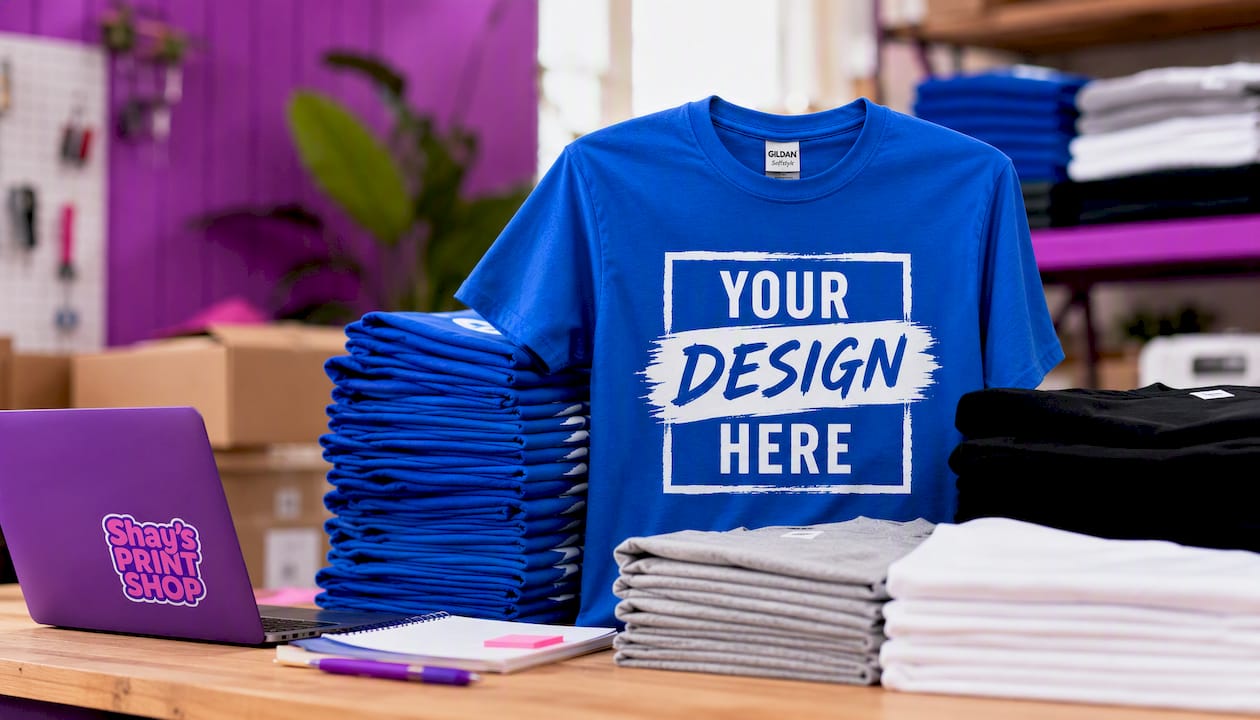
Our custom t-shirts start at 10 for $99, printed on 100% cotton with DTF, and we handle mixed styles, women’s cuts, and youth sizing as separate runs within the same order, exactly the way this guide recommends. For your quote, send us your total headcount, audience type, styles needed, and any sizes you already have confirmed. Check out our bulk ordering guide for full details on what to prepare, then reach out to start your order.
Where to Verify These Numbers Yourself
If you want to run your own calculation before placing an order, these tools and studies back the recommendations above.
- T-Shirt Size Breakdown Calculator: Plug in your headcount for an instant baseline distribution across all sizes.
- Event T-Shirt Quantity Calculator: Useful specifically for checking buffer percentages against your group size.
- Merch Club’s Size Breakdown Tool: Good for comparing audience presets side by side before you commit to one.
- Group-size distribution research: For readers who want the statistical reasoning behind why these percentage patterns hold up across group types.
Sources
- T-Shirt Size Breakdown Calculator: How Many of Each?
- Event T‑Shirt Quantity Calculator – Online by Size Distribution
- Bulk T-Shirt Size Breakdown Calculator | Merch Club
- Universal growth of social groups: empirical analysis and modeling - IOPscience
0 comments