

For most wedding invitations, a 110–120 lb cover stock (roughly 300–350 gsm) in smooth or lightly textured matte is the safest, most versatile starting point. It feels substantial in the hand, photographs well, and works with the widest range of print methods. That said, a few situations call for something different right away: letterpress or deep foil designs need 100% cotton stock, rustic weddings often look better on kraft, and eco-conscious couples should look at recycled or seed paper from the start.
Your two immediate next steps: order physical samples before committing to any stock, and confirm your printer’s maximum media weight. Colors, textures, and rigidity read completely differently on screen versus in your hands.
- Default pick: typical smooth or lightly textured matte cardstock
- Letterpress or foil: 100% cotton, 300 gsm and up
- Rustic or bohemian: kraft, 290 gsm range
- Eco-friendly: recycled or seed/plantable paper
- Vellum: use as a translucent overlay, not a standalone card
- First action: request physical samples and a printed proof before your full run
Shaysprintshop offers custom invitation and card printing with US-based fulfillment, so you can request samples and proofs without the guesswork of overseas shipping timelines.
Table of Contents
- What are the most common invitation paper types?
- How does paper weight work, and what thickness do you actually need?
- Which printing method works with which paper?
- How do you choose the right paper for your wedding invitations?
- Where should you order paper samples and proofs?
- What are the industry rules of thumb for wedding invitation paper?
- Key Takeaways
- The part most couples get backwards
- Ready to print your invitations with Shaysprintshop?
- Useful sources for deeper reading
What are the most common invitation paper types?
Understanding what each stock looks and feels like is the fastest way to narrow your options. Here is a rundown of the papers you will encounter most often, along with what each one is actually good for.
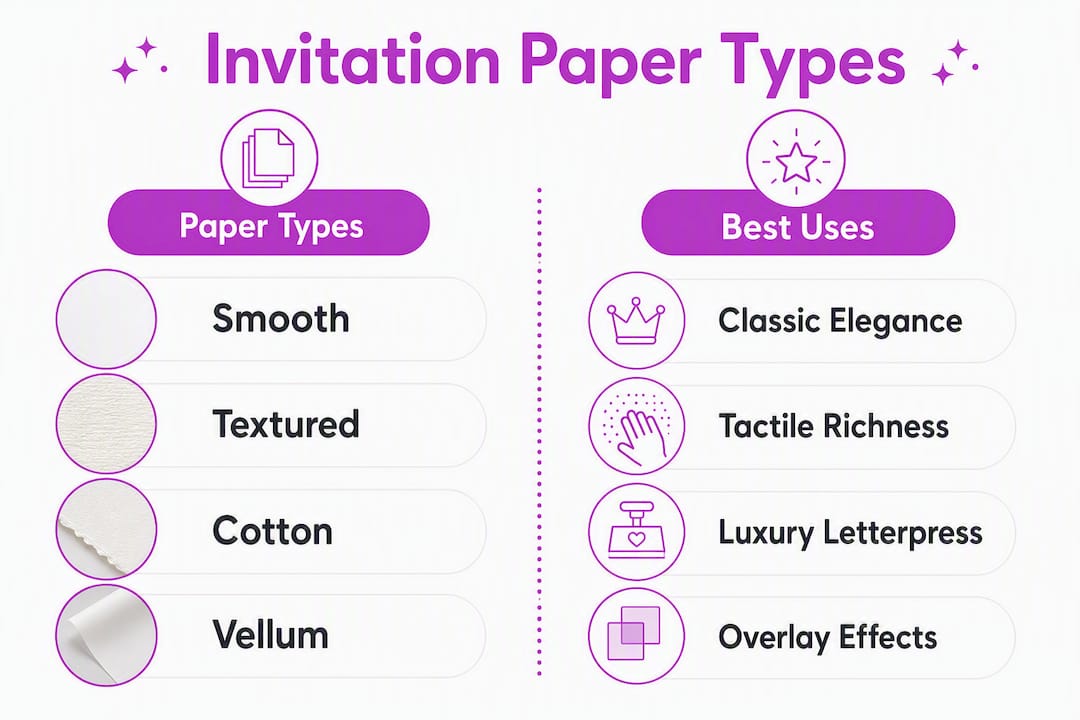
| Paper Type | Best for (style/use-case) | Typical weight (lb / gsm) | Texture / finish | Printing compatibility | Typical price / availability |
|---|---|---|---|---|---|
| Smooth cardstock | Modern, minimalist, photo-heavy | typical cover weight | Flat, crisp | Digital, laser, offset, foil | Low / widely available |
| Cotton / rag | Formal, letterpress, luxury | heavier weight cotton stocks | Soft, slightly toothy | Letterpress, engraving, digital | High / specialty vendors |
| Linen | Traditional, classic formal | common midweight range | Woven grid pattern | Digital, offset | Medium / widely available |
| Felt | Soft formal, tactile luxury | common midweight range | Subtle fiber texture | Digital, offset | Medium / specialty vendors |
| Vellum | Modern overlay, botanical | light, translucent weight | Translucent, smooth | Laser (carefully), digital | Medium / craft stores |
| Kraft | Rustic, bohemian, outdoor | common midweight | Rough, natural | Digital, white ink | Low–medium / widely available |
| Parchment | Vintage, antique, formal | typical weight range | Slightly mottled | Digital, laser | Low–medium / widely available |
| Recycled | Eco-conscious, casual–formal | common weight range | Varies (smooth to flecked) | Digital, offset | Medium / specialty vendors |
| Handmade / deckle-edge | Artisan, romantic, garden | typical heavier weight range | Rough torn edges, fibrous | Digital (carefully), letterpress | High / artisan vendors |
| Pearlescent / metallic | Glamorous, black-tie, modern | typical midweight range | Shimmery, smooth | Digital, laser, foil | Medium–high / specialty vendors |
| Seed / plantable | Eco-forward, outdoor, garden | common midweight | Rough, fibrous | Digital (limited) | High / specialty vendors |
What each stock actually feels like
Smooth cardstock is the workhorse. It feels clean and flat, photographs sharply, and takes ink without bleeding. If your design has hairline fonts or a full-bleed photo, this is your paper.
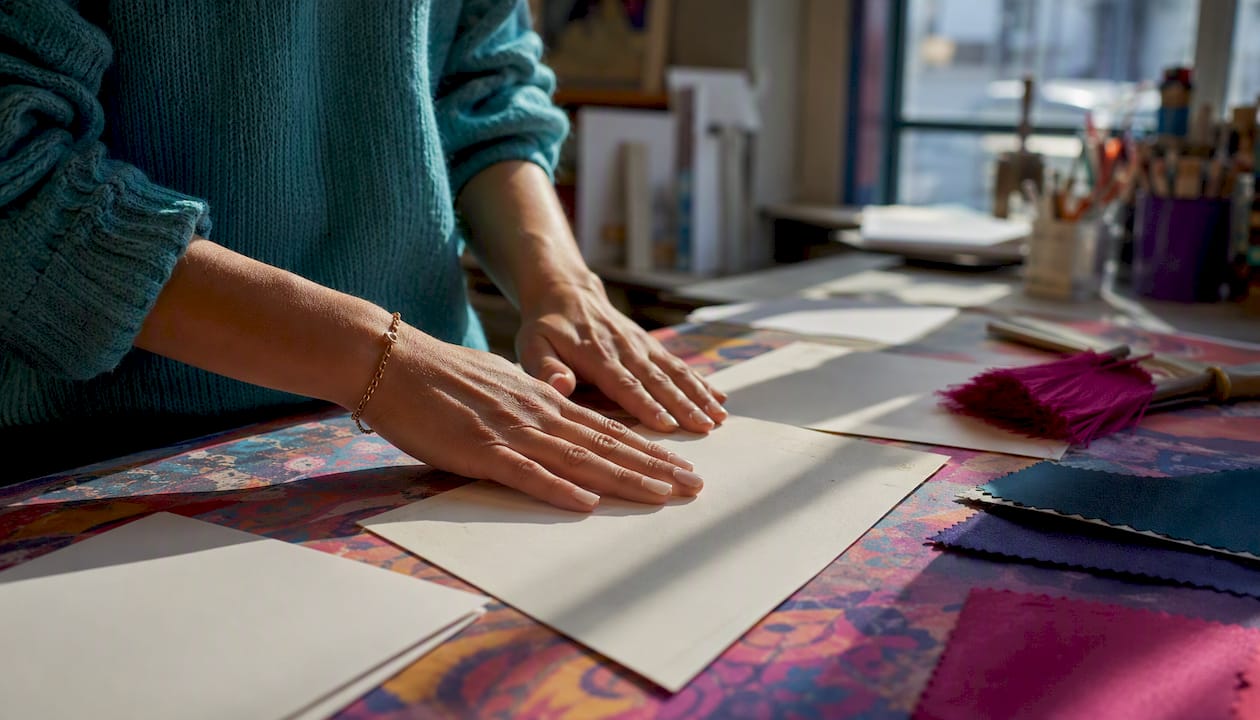
Textured invitation paper adds a tactile dimension that smooth stock simply cannot replicate. Linen has a subtle woven grid you can feel with a fingertip. Felt is softer and more diffuse. Both suit traditional or formal aesthetics, though very fine typography can look slightly softened on heavy textures.
Cotton / rag is in a category of its own. It has a soft, slightly toothy surface that holds a letterpress deboss beautifully. Wild Cotton at 300 gsm or 600 gsm is the go-to for deep impression work. It photographs with a handmade richness that no synthetic stock matches.
Vellum is translucent and delicate. Use it as a printed overlay on top of a cardstock base card, not as a standalone invitation. It adds a botanical or modern-romantic layer without replacing the structural card beneath.
Kraft reads immediately as rustic or bohemian. White ink prints cleanly on it, and digital printing works well. At 290 gsm it has enough body to feel intentional rather than cheap.
Seed and plantable paper is embedded with wildflower or herb seeds. Guests plant it after the wedding. The texture is rough and fibrous, and print options are limited, but the concept resonates strongly for outdoor or garden weddings.
Pro Tip: Pair a textured main card with smooth inserts. You get the tactile richness guests notice when they open the envelope, while your RSVP card and detail card stay crisp and easy to write on.
For pre-wedding events like a wine night or bridal gathering, the tone of your invitation matters as much as the paper itself. Matching stock to event mood applies whether you are sending formal wedding invites or casual party cards.
How does paper weight work, and what thickness do you actually need?
Paper weight is the spec that trips up most couples. There are two systems in use, and they measure different things.
Lb (pound) cover weight is a US measurement based on the weight of 500 sheets at a standard size. Cover stock and text stock use different base sizes, so a “100 lb text” sheet is actually much lighter than a “100 lb cover” sheet. Always confirm you are looking at cover weight when shopping for invitation cardstock.
GSM (grams per square meter) is a universal metric. It measures one square meter of the sheet regardless of size, so it is directly comparable across paper types. A higher gsm always means a heavier, thicker sheet.
| Weight (lb cover / gsm) | Feel | Common use |
|---|---|---|
| — | Noticeably thin, flexible | Casual flyers, not recommended for invitations |
| 80 lb / 216 gsm | Lightweight card | Budget inserts, RSVP cards, home printing |
| 100 lb | Solid, professional | Casual invitations, inserts, programs |
| 110 lb / 300 gsm | Rigid, premium | Standard wedding invitations |
| 120 lb | Very rigid, luxury feel | Formal wedding invitations, high-end suites |
| 350–600 gsm | Ultra-thick, double-ply | Letterpress, deep deboss, luxury statement pieces |
The industry standard for wedding invitations sits at 110–120 lb cover (300–350 gsm). That range gives you a rigid, premium hand-feel while staying mail-friendly. Go lighter and the card feels flimsy. Go heavier and you are in specialty territory that requires a professional press and often a custom postage quote.
Finishes and what they mean in practice
Smooth matte is uncoated and flat. Ink sits on the surface cleanly, colors look slightly softer than on coated stock, and the paper is easy to write on. It is the professional’s choice for hairline fonts and fine typography.

Satin / soft-touch has a very light coating that adds a subtle sheen without going glossy. It feels velvety and photographs beautifully.
Gloss / coated makes colors pop and photos look vivid. The trade-off: coated stocks are harder to write on, which makes them a poor choice for RSVP cards where guests need to fill in their names.
Pearlescent / shimmer has a metallic particle coating that catches light. It reads as glamorous and works well for black-tie or evening weddings.
Uncoated covers everything without a surface treatment, including matte, linen, felt, and kraft. Uncoated stocks absorb ink rather than sitting on top of it, which gives colors a softer, more organic look.
Pro Tip: Texture softens fine typography. If your design uses script fonts under 10pt or hairline strokes, choose smooth matte over linen or felt. Save the texture for designs with bold lettering or illustrative elements.
Which printing method works with which paper?
Your print method and your paper choice are locked together. Pick one without thinking about the other and you risk a failed order or a result that looks nothing like the proof.
| Print method | How it works | Best paper families | Min. weight | Notes |
|---|---|---|---|---|
| Digital / inkjet | Ink sprayed onto surface | Smooth, matte, linen, pearlescent | 80 lb / 216 gsm | Widest compatibility; check gsm limit on home printers |
| Laser | Toner fused with heat | Smooth, matte, linen | 80 lb / 216 gsm | Avoid heavy textures; heat can warp vellum |
| Offset | Ink pressed via plate | Smooth, matte, linen, recycled | 80 lb / 216 gsm | Best color consistency for large runs |
| Letterpress | Die pressed into stock | 100% cotton only | 300 gsm+ | Cotton required for clean deboss; up to 600 gsm for deep impressions |
| Foil stamp | Metallic foil heat-applied | Smooth, soft-touch, cotton | 100 lb | Needs flat, firm surface; avoid heavy textures |
| Engraving / thermography | Raised ink or die-cut | Smooth, cotton | 100 lb | Thermography mimics engraving at lower cost |
| Home inkjet | Consumer printer | Smooth, matte, linen | 80–100 lb / 216 gsm | Hard cap around 216 gsm on most consumer models |
Most home printers top out around 216 gsm (roughly 80–100 lb cover). Running 300 gsm stock through a consumer inkjet usually causes jams or feed errors. Check your printer’s spec sheet for maximum media weight before you order a stack of 200 sheets.
Pro Tip: If you want letterpress but your budget is tight, ask about thermography. It creates a raised ink effect that photographs similarly to letterpress at a fraction of the cost, and it works on smooth or lightly textured stock rather than requiring expensive cotton.
Questions to ask your printer before you order
- What is the maximum paper weight your press can handle?
- Do you offer printed proofs on the actual stock before the full run?
- How do you handle color matching across different paper finishes?
- What is your turnaround time, and does it include proofing rounds?
- What is your minimum order quantity for specialty stocks?
- Can you print white ink, foil, or metallic on the stock I have chosen?
- What envelope weights and liner options do you carry?
- Can you provide a postage estimate based on the finished suite weight?
How do you choose the right paper for your wedding invitations?
Start with your wedding’s tone, then work through the practical constraints. Here is the order that actually matters.
-
Match paper to event tone. Formal black-tie weddings call for heavy smooth matte or cotton. Rustic outdoor weddings suit kraft or recycled. Garden or bohemian events work well with handmade or deckle-edge. Casual celebrations can use lighter uncoated stocks without feeling cheap.
-
Consider your design’s detail level. Fine script fonts, hairline borders, and photo-heavy layouts need smooth stock. Bold lettering, illustrative designs, and simple layouts can handle texture without losing clarity.
-
Lock in your print method first. If you want letterpress, you need cotton. If you are printing at home, you are capped at roughly 216 gsm. Decide the method, then choose compatible paper.
-
Think about mailability and postage. Heavier suites cost more to mail. A 110 lb main card with 80 lb inserts keeps the suite feeling premium while controlling weight. Mixing weights across a suite is standard practice among professional stationers.
-
Consider guest handling. Will guests need to write on any piece? RSVP cards and detail cards should be uncoated so ink from a pen adheres cleanly.
-
Set your budget early. Cotton and handmade stocks cost significantly more than smooth cardstock. Pearlescent and specialty finishes add cost at the printing stage too. Know your per-piece budget before you fall in love with a stock.
Pro Tip: Order a sample kit before you finalize anything. Feeling the paper in hand often matters more than any spec number. A 110 lb linen and a 110 lb smooth matte weigh the same on paper but feel completely different in an envelope.
Red flags to watch for
- A vendor who offers digital mockups only, with no physical sample option
- No clear answer on which print method produces the specialty finish you want
- No mailing durability guarantee for heavy or unusual stocks
- Turnaround times that do not include proofing rounds
Where should you order paper samples and proofs?
Order samples early, before you finalize your design. Here is how to do it right.
- Specialty paper vendors (online and local) often sell sample packs by finish family. Request the exact weight and finish you are considering, not a generic swatch book.
- Your print shop or stationer should be able to provide a printed proof on the actual stock. A digital proof on screen is not a substitute.
- Local craft and paper stores carry a limited range but let you feel stock immediately without waiting for shipping.
- Paper mills sometimes offer direct sample requests for professional quantities. Worth asking if you are ordering a large run.
When you request a sample, ask for: the exact finish and weight you plan to order, a printed color test if possible, an envelope pairing in the same or complementary stock, and a liner sample if you want lined envelopes.
Pro Tip: Compare samples under natural daylight, not just indoor lighting. Pearlescent and shimmer stocks look dramatically different under different light sources. Photograph the samples next to your color swatches and share the photos with your designer before approving.
Allow time in your planning for sample shipping, a proofing round, any revisions, and press time. For most professional print shops, that process takes two to four weeks before your full run even starts.
Shaysprintshop’s custom stationery page is a good starting point for exploring invitation options and understanding what proofing looks like before you commit to a full order.
What are the industry rules of thumb for wedding invitation paper?
The 110–120 lb cover weight range (300–350 gsm) is the baseline the stationery industry uses for wedding invitations. Below that range, cards feel lightweight and less formal. Above it, you are in premium territory that requires professional printing equipment.
Three rules that hold across almost every wedding invitation project:
- Always order physical samples and a printed proof before your full run. Colors and textures shift substantially when ink meets a specific substrate. A digital proof is a starting point, not a final check.
- Match textured stocks to larger, bolder typography. Fine hairlines and small script fonts lose definition on linen, felt, or eggshell. Smooth matte stays the professional’s choice for detail-heavy designs.
- Use a hybrid weight suite to balance luxury and postage. A 110–120 lb main invitation card paired with 80 lb inserts keeps the suite feeling premium without pushing you into non-standard postage territory.
Pro Tip: Ask your post office to hand-cancel your invitations if they include wax seals, ribbon, or unusual enclosures. Machine processing can damage delicate finishes and specialty stocks.
Key Takeaways
For wedding invitations, the right paper choice comes down to three things: matching the stock to your event’s tone, confirming compatibility with your print method, and always ordering physical samples before your full run.
| Point | Details |
|---|---|
| Start with 110–120 lb cover | Industry standard at 300–350 gsm gives a premium feel while staying mail-friendly. |
| Match texture to design detail | Use smooth matte for fine typography and photos; save linen or felt for bold, tactile designs. |
| Confirm your print method first | Letterpress needs 100% cotton at 300 gsm+; home printers cap around 216 gsm. |
| Always order physical samples | Colors and textures shift from screen to paper; a printed proof is non-negotiable before a full run. |
| Shaysprintshop for custom invitations | Order printed proofs and finished invitation cards through Shaysprintshop’s US-based fulfillment for fast turnaround. |
The part most couples get backwards
There is a pattern that shows up repeatedly in invitation planning: couples spend hours choosing a paper stock from a screen, approve a digital proof, and then open their finished order to find the color is off or the texture feels nothing like they expected.
The paper choice is not a visual decision. It is a tactile one. The weight of the card in a guest’s hand, the way it sounds when it slides out of the envelope, the slight resistance of a linen texture under a fingertip — none of that translates to a monitor. Professional stationers know this, which is why the sample step is treated as mandatory in the industry, not optional.
The other mistake is choosing paper before locking in the print method. Cotton stock is genuinely beautiful, but if your printer runs digital and not letterpress, that stock will not perform the way you are imagining. The deboss impression that makes cotton so distinctive only happens under a letterpress die. Digital ink on cotton looks fine, but it does not look like letterpress. Choosing the paper first and the method second is how couples end up disappointed with results that are technically correct but not what they pictured.
Start with the method. Then choose the paper that makes that method sing.
Ready to print your invitations with Shaysprintshop?
Choosing the right paper is only half the equation. Getting a clean, accurate print on that paper is where most DIY orders go sideways. Shaysprintshop handles custom invitations and cards with US-based fulfillment, fast turnaround, and real proofing support so you know exactly what you are getting before your full run ships.
You upload your design, choose your finish, and Shaysprintshop takes care of the rest. No guessing about printer compatibility, no surprise color shifts, and no waiting weeks for overseas shipping. If you are also coordinating custom apparel for your wedding party or event staff, the custom shirts and apparel page covers bulk personalized options starting at 10 shirts for $99. Get your invitation proof started today at Shaysprintshop.
Useful sources for deeper reading
These are the most reliable references for invitation paper specs, print compatibility, and stock selection:
- Wedding Invitation Paper and Cardstock: Types, Weights, and How to Choose — ThePerfectWedding.com covers weight standards and the 110–120 lb industry baseline in detail.
- Wedding Invitation Paper and Cardstock Guide — Paperlust explains letterpress cotton requirements, home-printer limits, and gsm conversions clearly.
- Textured vs. Smooth Invitation Paper: How to Choose — Practical guidance on when texture helps and when it hurts, with a strong case for physical samples.
- Invitation Paper Buying Guide: Weight, Finish & Envelopes — Paper-direct walks through finish definitions and the matte-as-safe-default recommendation.
- Bella Figura Papers Overview — Useful reference for hybrid-weight suite practices and envelope pairing options.
- Cards & Invitations at Shaysprintshop — Starting point for ordering custom printed invitations with US-based fulfillment and proofing support.
0 comments