

For most outdoor, water bottle, and dishwasher-safe projects, pick a laminated cast or high-quality calendared vinyl sticker with a UV-protective overlaminate. That combination handles rain, sun, and repeated washing better than any unlaminated print, no matter how “waterproof” the base material claims to be.
This works best for:
- Water bottles and tumblers that get washed daily
- Car bumpers and window decals exposed to weather
- Outdoor gear, coolers, and hard hats
- Yard signs and storefront signage
Two trade-offs matter before you order in bulk. Cast vinyl costs more but conforms to curves and rivets far better than calendared vinyl, which is cheaper and fine for flat surfaces. Glossy overlaminate resists UV slightly better in some product lines, while matte hides scratches and fingerprints on handled items like tumblers.
Pro Tip: Ask any supplier for the overlaminate’s datasheet and stated outdoor durability rating before placing a bulk order. A vendor that can’t produce one is guessing, not testing.
Key Takeaways
Laminated cast or calendared vinyl with a UV-protective overlaminate delivers the outdoor and dishwasher-safe performance most buyers expect from waterproof vinyl stickers.
| Point | Details |
|---|---|
| Overlaminate drives durability | The protective laminate, not the base vinyl, determines UV resistance and outdoor lifespan. |
| Match material to surface | Cast vinyl conforms to curves; calendared vinyl suits flat, cost-sensitive projects. |
| Check datasheets, not marketing | Ask suppliers for outdoor durability ratings and chemical resistance test data before bulk orders. |
| Request a sample first | Test color, finish, and adhesion on your actual surface before committing to hundreds of units. |
| Shay’s Print Shop offers laminated die-cuts | Glossy and matte finishes in 2", 3", and 4" sizes with bulk pricing from 10 to 1,000 pieces. |
Table of Contents
- What Makes a Vinyl Sticker Waterproof?
- Which Material and Finish Fits Your Project?
- Die-Cut, Kiss-Cut, or Sheets: Which Cut Style Fits?
- What Files Do You Need to Submit for Printing?
- How Long Do Waterproof Vinyl Stickers Actually Last?
- How Do You Apply and Remove Vinyl Stickers Without Damage?
- What Do Overlaminate Datasheets Actually Tell You?
- How Do Waterproof Vinyl Sticker Suppliers Compare?
- What Does Pricing Actually Look Like, Including Shipping?
- What Are Typical Minimum Orders and Customization Options?
- What Do Customer Reviews Reveal About Sticker Quality?
- Should You Request a Sample Before Ordering in Bulk?
- Publisher Perspective: When to Choose Laminated Custom Stickers
- Ready to Order Your Custom Vinyl Stickers?
- Frequently Asked Questions
- Sources
What Makes a Vinyl Sticker Waterproof?
A sticker is waterproof when water can’t reach the printed ink layer at all. That’s different from “water-resistant,” which just means it survives a splash before eventually degrading. True waterproofing comes from three parts working together: a printable vinyl face stock, non-soluble ink, and a protective laminate sealing everything from moisture and UV rays.
The laminate does more work than most buyers assume. Industry analysis of label durability points to the overlaminate, not the vinyl face stock, as the biggest factor in how long a sticker actually survives outdoors, since it’s what blocks UV degradation and chemical exposure before either reaches the print. Cheap stickers often skip this layer entirely, relying on “waterproof vinyl” marketing language while leaving the ink exposed to fading and lifting.
Ink type matters too. Pigment-based inks generally hold color longer under UV exposure than dye-based inks, though the difference shows up over months, not days. Home printing instructions for waterproof sticker kits confirm this directly: the laminating sheet blocks UV rays and protects the ink, but the manufacturer still recommends UV-resistant ink for anything facing prolonged sun exposure.
A sticker printed on waterproof vinyl but left unlaminated is not a waterproof sticker. It’s a sticker that will survive a rainstorm and lose its color within a season.
Before ordering, check for these signals from any supplier:
- A named overlaminate product (not just “protective coating”)
- A stated outdoor life in years, not vague terms like “long-lasting”
- Confirmation of pigment ink for anything going outside
Which Material and Finish Fits Your Project?
Cast vinyl and calendared vinyl solve different problems. Cast vinyl is thinner, more flexible, and holds shape on curved or textured surfaces like bumpers, helmets, and rounded tumblers. It also tends to carry a longer outdoor durability rating. Calendared vinyl is thicker and less flexible, but it costs less and performs perfectly well on flat surfaces like laptop lids, toolboxes, and indoor signage.
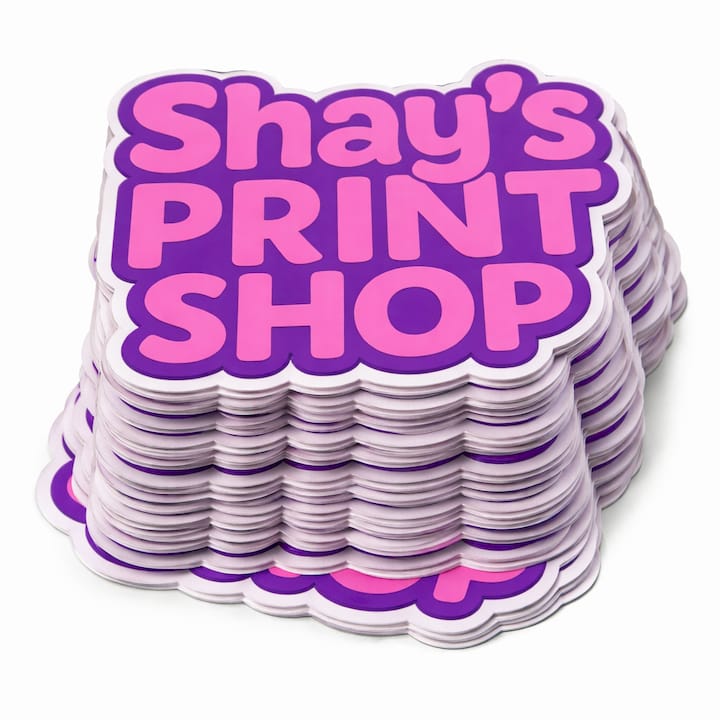
The overlaminate you pair with either material determines most of the real-world performance. A gloss finish tends to show off color vibrancy and works well for retail packaging or promotional decals meant to catch the eye. Matte finish reduces glare and fingerprint visibility, which makes it a better pick for tumblers and phone cases that get handled constantly. Both finishes can carry UV and scratch protection. The difference is cosmetic more than functional in most product lines.
Adhesive choice is the part buyers skip past too fast. Permanent acrylic adhesive is standard for anything outdoors, on vehicles, or on drinkware that gets washed repeatedly. Removable adhesive suits temporary promotions, seasonal window clings, or rental properties where residue-free removal matters more than longevity.
| Use Case | Recommended Vinyl | Overlaminate Finish | Adhesive |
|---|---|---|---|
| Water bottles & tumblers | Cast vinyl | Matte | Permanent acrylic |
| Vehicle & bumper decals | Cast vinyl | Gloss | Permanent acrylic |
| Marine equipment | Cast vinyl | Gloss (chemical-resistant) | Permanent acrylic |
| Indoor signage & packaging | Calendared vinyl | Gloss or matte | Permanent or removable |
Marine environments deserve extra scrutiny. Salt exposure eats through standard laminates faster than sun alone, so look for an overlaminate with documented salt-spray resistance built for long-term outdoor exposure.
Pro Tip: Don’t take “chemical resistant” at face value. Ask what chemicals the overlaminate was tested against. Saltwater, gasoline, and dishwasher detergent are three very different tests.
Die-Cut, Kiss-Cut, or Sheets: Which Cut Style Fits?
Die-cut stickers are cut all the way through both the vinyl and backing paper, following the exact outline of your design. Kiss-cut stickers only cut through the vinyl layer, leaving the backing sheet intact so the sticker peels off individually while staying on a shared sheet. Choose die-cut when you want a clean, standalone shape for giveaways or product labels. Choose kiss-cut when you’re handing out multiple designs from one sheet or want easy peel-and-apply for events.
Production format matters just as much as the cut style:
- Individual die-cuts work best for mailers, giveaways, and single-item packaging
- Sheets suit retail sales, sticker packs, and multi-design promotions
- Rolls fit high-volume machine application, like labeling hundreds of products on a line
- Cut-to-size sheets work for large format signage or vehicle graphics that don’t need a die-cut outline
Sizing depends on where the sticker ends up. Here’s how that typically breaks down:
- 2 inches — packaging labels, small branding on product boxes
- 3 inches — event giveaways, water bottle stickers, laptop corners
- 4 inches — laptop decals, tumbler wraps, storefront window displays
- Custom shapes — logo-specific branding that needs an exact outline
Small stickers with tight corners need extra attention during file prep. Anything under an inch with sharp points risks the vinyl lifting at the tip during application, so most print shops recommend a minimum corner radius and a small bleed margin around the artwork edge to avoid white slivers after cutting.
What Files Do You Need to Submit for Printing?
Vector files print cleanest. PDF, AI, or EPS formats scale without losing edge sharpness, which matters most on die-cut shapes where the cut line follows your artwork exactly. If your design started as a raster image (a photo or a design pulled from Canva, for example), export it as a high-resolution PNG or TIFF at a minimum of 300 dpi at the final print size, not scaled up afterward.
Before uploading, run through this checklist:
- Convert all text to outlines so fonts don’t shift on someone else’s system
- Flatten layers unless the print shop asks for layered files
- Add bleed (usually 0.125 inches) beyond the cut line
- Keep critical text and logos inside the safe zone, away from the edge
- Set your color profile to CMYK, since RGB colors shift when converted for print
Most shops run a digital proof before production starts. Expect to approve exact colors, sizing, and cut lines within a day or two of upload. If you’re ordering a few thousand units, request a physical sample first. A screen proof won’t show you how matte finish looks on a tumbler under kitchen lighting.
Pro Tip: If your design includes white text, a logo, or transparent sections, ask whether you need a white underprint layer or if the print shop can produce the job directly on white vinyl. Skipping this step is the most common reason first-time orders come back with washed-out colors.
How Long Do Waterproof Vinyl Stickers Actually Last?
Realistic outdoor life for a laminated vinyl sticker runs anywhere from one to five-plus years, and the range depends almost entirely on four variables: the overlaminate’s UV rating, ink type, the surface it’s applied to, and how much sun, salt, or chemical exposure it takes on.
Avery Dennison’s DOL 1300 Series overlaminate datasheet lists an outdoor durability rating of up to four years for certain gloss and matte finishes, tested specifically for abrasion and chemical resistance. That figure applies to a specific product line under stated conditions, not every laminated sticker on the market, which is exactly why datasheet numbers matter more than a vendor’s general marketing copy.
Failure shows up in a few predictable ways:
- Edge lifting — usually from poor surface prep or a cheap adhesive that never bonded fully
- UV fade — most common with dye-based inks and no overlaminate
- Adhesive loss — accelerated by heat cycling, like a car dashboard in summer
- Chemical attack — solvents, gasoline, and dishwasher detergent can degrade laminates not rated for them
For anything marketed as dishwasher-safe, ask how that claim was tested. Vendors define “dishwasher safe” differently. Some test hand-washing only, while others put samples through repeated commercial dishwasher cycles. That distinction matters if you’re labeling drinkware for daily use versus occasional handwash items.
Pro Tip: For water bottle stickers dishwasher safe claims specifically, request the vendor’s actual test method. “Hand-wash tested” and “commercial dishwasher tested” are not interchangeable claims, even when both get labeled dishwasher safe.
How Do You Apply and Remove Vinyl Stickers Without Damage?
Getting a clean, bubble-free application starts before the sticker ever touches the surface.
- Clean the surface thoroughly with isopropyl alcohol and let it dry completely.
- Peel back a small section of the backing, aligning the sticker before committing to full contact.
- Apply from center outward using a squeegee or credit card to push out air bubbles.
- On curved surfaces, use a heat gun or hair dryer on low heat to help the vinyl conform without stretching or tearing.
- Let the adhesive set for at least 24 hours before washing or heavy handling.
Removal works best with heat. Warm the sticker with a hair dryer to soften the adhesive, then peel slowly at a low angle. Leftover residue usually comes off with rubbing alcohol or a dedicated adhesive remover, though always test a small spot first on painted or powder-coated surfaces.
Textured plastics and powder-coated metal need extra patience during application since the vinyl won’t seal into every groove immediately. Press firmly along texture lines and recheck edges after a few hours.
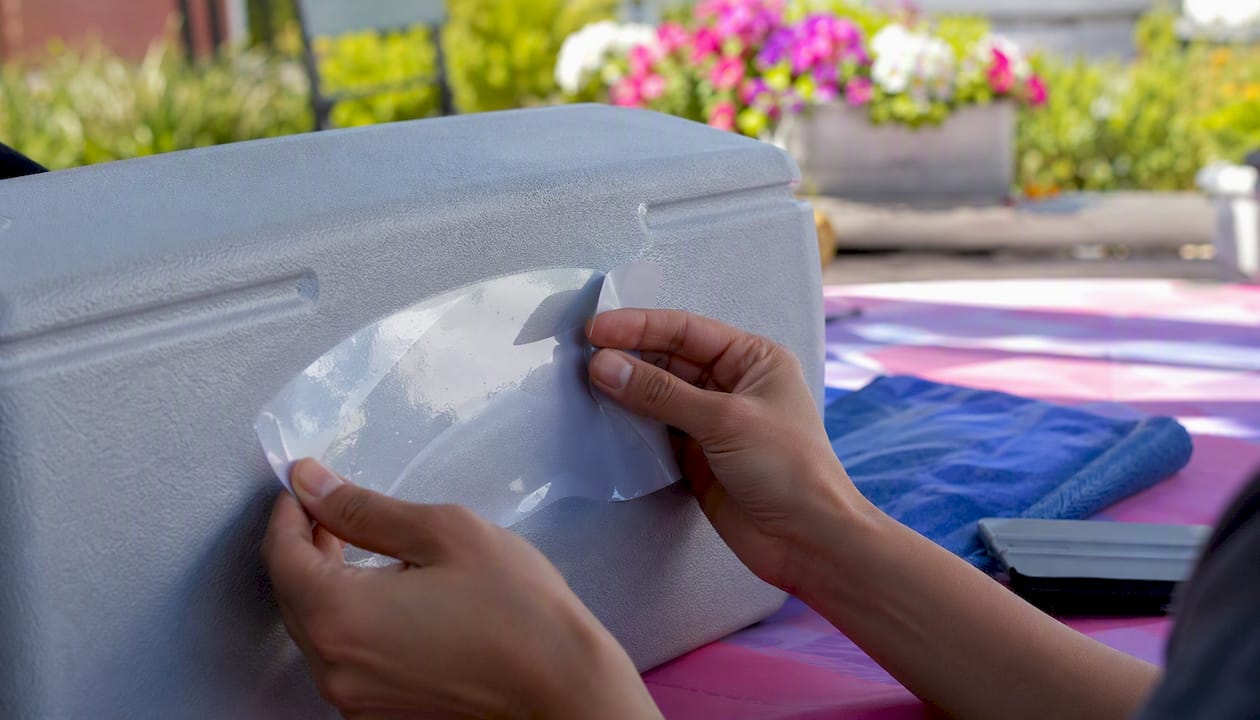
Pro Tip: For vehicles and marine equipment, apply in moderate temperatures, ideally 50 to 90°F. Cold vinyl becomes brittle and hard to conform, while extreme heat can cause premature adhesive bonding before you’ve finished aligning the piece.
What Do Overlaminate Datasheets Actually Tell You?
Marketing pages say “waterproof” and “UV resistant.” Datasheets say exactly how long, under what test conditions, and against which chemicals. That gap is where buyers get burned on bulk orders.
Avery Dennison’s DOL1300Z Series datasheet, for instance, specifies gloss, luster, and matte finish options and states use cases including fleet, vehicle, and marine applications with documented UV and chemical resistance. That level of specificity, tied to named test standards, is what separates a manufacturer datasheet from a product page that just says “durable.”
| Spec Field | What It Tells You |
|---|---|
| Outdoor durability (years) | Expected lifespan under normal sun exposure before noticeable fade or lift |
| Chemical resistance | Which solvents, fuels, or cleaning agents the laminate withstands |
| Finish type | Gloss, luster, or matte, affecting glare and scratch visibility |
| Application use cases | Fleet, marine, POP display, or general outdoor signage |
When you read a datasheet, focus on four fields: stated outdoor durability, any named test standard like ASTM ratings, chemical resistance notes, and the recommended application temperature range. That last one matters more than people expect. Applying laminated vinyl outside its rated temperature window, as Avery Dennison’s application guidance notes, can cause silvering or poor bonding even on a premium laminate.
A four-year outdoor rating doesn’t mean the sticker vanishes on day 1,461. It means the manufacturer tested visible fade and adhesion up to that point and expects the sticker to still look presentable. Budget replacement cycles around that number rather than assuming indefinite life.
How Do Waterproof Vinyl Sticker Suppliers Compare?
Search any marketplace for waterproof vinyl stickers and you’ll find hundreds of sellers at wildly different price points and quality tiers. Large marketplaces list dozens of competing SKUs across sizes and finishes, which shows how much variability exists between sellers claiming the same “waterproof” label.
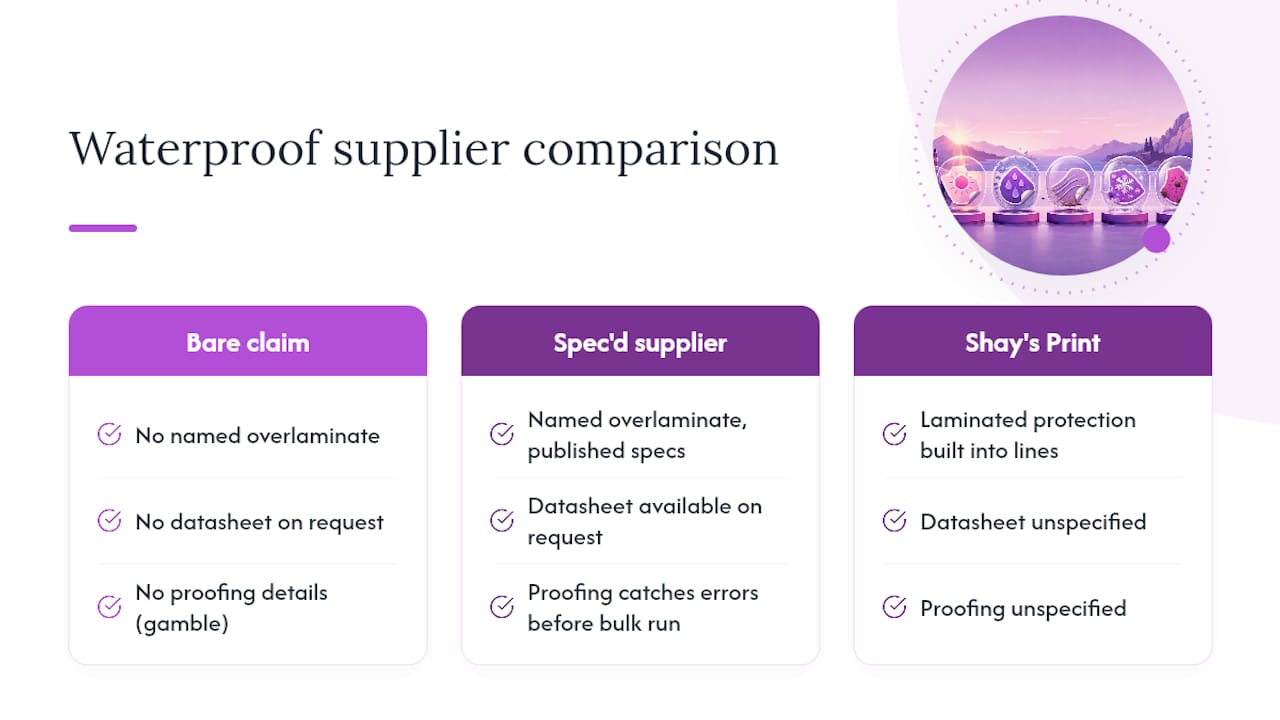
The gap between suppliers usually comes down to three things: whether they use a named overlaminate product with published specs, whether they’ll show you a datasheet on request, and whether their proofing process catches color or sizing errors before a bulk run ships. A supplier that answers all three with specifics is worth paying slightly more for. One that answers with “yes, it’s waterproof” and nothing else is a gamble on a large order.
Price alone tells you very little. A rock-bottom quote per sticker often means calendared vinyl with no overlaminate at all, fine for a short-term giveaway but a poor fit for anything going on a water bottle or car bumper. Compare quotes at the same specification: same vinyl type, same overlaminate, same finish. Otherwise you’re not comparing prices, you’re comparing two different products that happen to look similar on a screen.
Shay’s Print Shop builds laminated protection into its die-cut sticker lines from the start, in both glossy and matte finishes, so the comparison starts from a durability baseline rather than a race to the lowest unlaminated price.
What Does Pricing Actually Look Like, Including Shipping?
Per-unit sticker pricing drops sharply as order volume increases, which is standard across the industry. A run of ten stickers costs far more per piece than a run of five hundred, since setup and die-cutting costs get spread across more units. Most suppliers publish tiered pricing starting around 10 pieces and scaling up toward 1,000 or more per order.
Beyond the base price, watch for these common add-ons:
- Rush production fees for turnaround faster than standard processing
- Proof revision charges if you request more than one or two design changes
- Custom die-cut setup fees for shapes outside standard circles and squares
- Shipping costs, which vary by order weight, destination, and speed selected at checkout
Bulk discounts make the biggest difference for event planners and small businesses ordering repeat batches. Buying 500 stickers instead of 100 for the same campaign often cuts the per-unit cost by more than half, which is why many buyers slightly over-order rather than reordering in small batches. Check whether a supplier bundles multiple sizes or finishes into one bulk tier, since some allow mixing 2", 3", and 4" stickers under a single volume discount while others price each size separately.
What Are Typical Minimum Orders and Customization Options?
Minimum order quantities vary more than most first-time buyers expect. Some suppliers accept orders as small as 10 stickers, which suits individuals testing a design or ordering for a small family event. Others set minimums in the hundreds, aimed squarely at businesses running promotional campaigns.
A 10-piece minimum gives you room to test a design on a small scale, an option worth using before committing to a 500-piece run. Shay’s Print Shop offers die-cut stickers in packs starting at 10 pieces up to 1,000, which covers both ends of that range without forcing a large upfront commitment.
Customization options typically include:
- Shape (circle, square, or fully custom die-cut outline)
- Finish (glossy or matte overlaminate)
- Size, most commonly ranging from 2 to 5 inches
- Material (standard vinyl, holographic, clear, or white base)
The more customization a supplier offers without raising the minimum order, the easier it is to test small before scaling up. If you need multiple sizes for one campaign, a giveaway sticker at 3 inches and a larger laptop decal at 4 inches, check whether the supplier lets you combine both under one bulk pricing tier or treats each size as a separate order with its own minimum.
What Do Customer Reviews Reveal About Sticker Quality?
Reviews tend to cluster around three concerns: color accuracy against the digital proof, how well the laminate held up after weeks of actual use, and whether the order arrived within the stated turnaround window. These three factors show up more consistently in feedback than price ever does, since a cheap sticker that peels within a month generates far more complaints than a slightly pricier one that lasts a year.
Vendor pages across the industry lean heavily on lamination and material quality as the deciding factor in dishwasher-safe and outdoor performance claims, and reader feedback tends to confirm that pattern. Buyers who report satisfaction almost always mention the laminate holding up under real conditions, not just the initial print quality out of the package.
Before trusting a five-star average blindly, look for reviews that mention specific use cases close to yours. A review praising color vibrancy on an indoor sign tells you little about how that same sticker performs on a car bumper through a summer of direct sun. Look for mentions of water bottles, dishwashers, or outdoor exposure specifically if that’s your intended use, since general satisfaction scores blend very different product applications together.
Should You Request a Sample Before Ordering in Bulk?
Yes, and skipping this step is the most common regret buyers report after a bulk order goes wrong. A sample shows you exactly how the finish looks under real lighting, how the adhesive grips your actual surface, and whether the color on screen matches the color in your hand.
Request a sample when any of the following apply:
- You’re ordering 250 pieces or more for the first time with a new supplier
- The sticker will go on a surface you haven’t tested before (textured plastic, powder-coated metal, curved glass)
- Color accuracy is critical for brand consistency across a full merch line
- You’re deciding between glossy and matte and can’t judge from a screen alone
Most suppliers that stand behind their product will offer a paid sample or a small starter pack rather than shipping a full run sight unseen. If a supplier resists sending a sample or can’t produce one quickly, treat that as a warning sign before committing to a larger order.
Publisher Perspective: When to Choose Laminated Custom Stickers
Shay’s Print Shop builds its die-cut stickers around lamination from the start, in glossy and matte finishes across common sizes, which matches exactly what most buyers researching waterproof vinyl stickers actually need: a bulk-friendly option that doesn’t force a tradeoff between price and durability.
That fit is strongest for event giveaways, branded merch runs, and small business promotions where turnaround speed and bulk pricing matter as much as the finished sticker’s outdoor life. Sample requests and proof approval are part of the standard order flow, giving you a checkpoint before committing to a full print run.
Ready to Order Your Custom Vinyl Stickers?
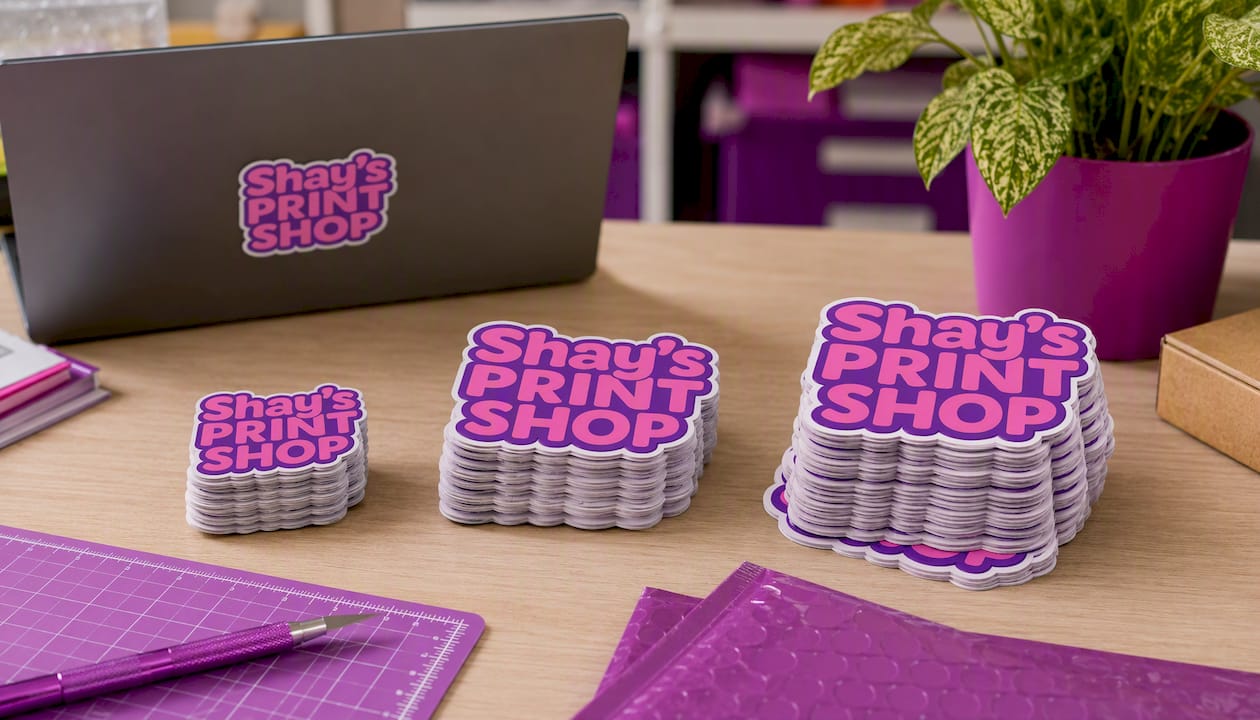
Shay’s Print Shop keeps sticker ordering simple: pick your size, pick your finish, upload your design, and get bulk pricing that actually makes sense for events, product packaging, or promotional giveaways. You’re not stuck choosing between a supplier who prints fast and one who laminates properly. Both come standard here.
Here’s the order flow in four steps:
- Choose your size (2", 3", or 4") and finish (glossy or matte)
- Upload your artwork, following the standard bleed and resolution guidelines
- Review and approve your digital proof
- Select your quantity and check out
Smaller giveaway or packaging jobs fit well on the 2" die-cut sticker line, while laptop decals and tumbler wraps usually land better at 4 inches. For most event and promo orders, the 3" die-cut option hits the sweet spot between visibility and per-unit cost, with packs running from 10 up to 1,000 pieces. Start your order today and get proof approval back before you’ve finished your coffee.
Frequently Asked Questions
Are vinyl stickers waterproof by default? Not automatically. Vinyl itself resists moisture reasonably well, but full waterproofing requires a protective overlaminate sealing the ink layer. An unlaminated vinyl sticker will eventually let water reach the print and cause fading or lifting.
Are vinyl stickers dishwasher safe? Laminated vinyl stickers designed for drinkware typically survive dishwasher cycles, though testing methods vary by supplier. Ask specifically whether “dishwasher safe” was verified through hand-washing or repeated commercial dishwasher cycles, since those claims aren’t interchangeable.
Can I print waterproof stickers at home? Yes, using a printable vinyl sheet paired with a separate laminating sheet. The laminate blocks UV and protects the ink from water, though home printer ink quality affects how well colors hold up over time compared to professional printing.
Are waterproof vinyl stickers safe for cars? Yes, when made with cast vinyl and a UV-resistant overlaminate rated for outdoor and vehicle use. Look for products specifically tested for fleet or vehicle applications, since they account for temperature swings and prolonged sun exposure that indoor-rated stickers aren’t built for.
How do I remove a vinyl sticker without damaging the surface? Warm the sticker with a hair dryer to soften the adhesive, then peel slowly at a low angle. Any leftover residue usually comes off with rubbing alcohol, though test a small spot first on painted or delicate surfaces.
Sources
- DOL1300Z Series product data sheet — Avery Dennison
0 comments