

Glossy is typically preferred for outdoor use, water bottles, and bold retail designs due to its superior moisture resistance and enhanced color vibrancy; matte is favored for premium product labels, photography-heavy artwork, and applications requiring writeability or reduced glare. The best finish depends on the specific use-case and substrate. Here’s how each finish plays out across the scenarios you’re most likely to face:
- Product packaging or retail shelf labels: Glossy for maximum shelf pop and color punch; matte for a premium, minimal look.
- Water bottles or drinkware: Glossy vinyl, because it repels moisture and oils better than matte.
- Laptop stickers or event giveaways: Either works, but matte hides fingerprints and photographs more cleanly.
- Car decals or long-term outdoor use: Glossy outdoor vinyl with UV laminate for the best fade resistance.
- Hand-labeled products or batch numbering: Matte every time, since pens and markers grip the surface reliably.
One thing to keep in mind: the finish is only part of the equation. The substrate (paper, film, or vinyl) and whether you add a UV-resistant laminate matter just as much for how long your sticker actually lasts.
Key Takeaways
Glossy wins for outdoor durability and color vibrancy; matte wins for premium appearance, photography, and writeability. The substrate and UV laminate matter more than finish for long-term longevity.
| Point | Details |
|---|---|
| Finish affects appearance, not longevity | Substrate (vinyl vs film vs paper) and UV laminate drive how long a sticker lasts outdoors. |
| Gloss for vibrancy and moisture resistance | Glossy surfaces repel water and oils better and amplify color saturation for retail and outdoor use. |
| Matte for premium feel and writeability | Matte hides fingerprints, reduces glare in photos, and accepts ballpoint pens without smearing. |
| Outdoor stickers can last for several years | Die-cut vinyl with the correct laminate can last up to five years outdoors, regardless of finish. |
| Shaysprintshop offers both finishes with proofing | Custom die-cut stickers in matte or glossy are available with digital proofs and sample runs before full production. |
Table of Contents
- How matte and glossy stickers compare across every key dimension
- How finish affects color, contrast, and perceived sharpness
- Glare, reflectivity, and how they affect what people can actually read
- Durability: how each finish holds up to water, UV, and daily wear
- Can you write on glossy or matte stickers? What you need to know
- Paper, film, and vinyl: how the substrate changes everything
- What actually drives sticker cost, and how to order without surprises
- How to choose the right finish for your project
- What Shaysprintshop sees customers order and why
- The finish choice most people overthink
- Shaysprintshop makes it easy to get the right sticker, right the first time
- Sources
How matte and glossy stickers compare across every key dimension
The table below covers the attributes that matter most when you’re deciding between a matte vs glossy finish. Scan the row that matches your biggest concern, and the right choice usually becomes obvious.
| Attribute | Matte | Glossy |
|---|---|---|
| Color / vibrancy | Softer, more natural tones; muted palettes look intentional | Richer, more saturated color; bold designs pop harder |
| Glare / readability | No glare; easy to read under any lighting | Reflective; can wash out text under direct light |
| Water / UV resistance | Good on quality vinyl; slightly less water-beading than gloss | Slightly better UV fade resistance; repels water and oils well |
| Scratch / fingerprint visibility | Hides fingerprints and minor scratches well | Shows fingerprints and smudges more readily |
| Tactile feel | Soft, velvety texture; feels premium | Smooth, slick surface; feels polished |
| Writeability | Accepts ballpoint and felt-tip pens reliably | Needs a permanent marker; most pens smear |
| Common use cases | Premium labels, photography, fine art, minimal branding | Retail products, promo stickers, water bottles, car decals |
| Relative cost | Comparable; slight premium possible for specialty matte laminates | Standard pricing; widely available at all quantity tiers |
The two trade-offs that trip people up most often are glare and fingerprints. Gloss looks stunning on a shelf but shows every thumbprint the moment someone picks it up. Matte stays cleaner-looking through handling, which is why premium cosmetic and food brands lean toward it for product labels. On the color side, gloss amplifies saturation and contrast while matte diffuses light for softer, more natural tones.
Pro Tip: Order a small sample run of both finishes before committing to a large quantity. View the samples under the actual lighting where your sticker will live — a retail shelf under fluorescents, a car window in direct sun, or a laptop screen in a dim room. The finish that looks best in those conditions is the one to order.
How finish affects color, contrast, and perceived sharpness
Gloss works by reflecting light back toward the viewer, which makes colors appear more saturated and contrast look sharper. That effect is why bold illustrations, brand logos with strong primary colors, and retail promotional stickers almost always look better in gloss. The visual intensity is real and immediate.
Matte does the opposite. It diffuses incoming light across the surface rather than bouncing it back, which softens the overall look. That’s not a flaw. For photography-based designs, fine line artwork, or palettes built around dusty, earthy, or pastel tones, matte renders detail more accurately because there’s no competing reflection to distort what you’re seeing. Matte often renders fine detail and small type more reliably under varied lighting, which matters a lot for labels with dense ingredient lists or small legal text.
A few practical design notes:
- Bold, single-color logos tend to gain from gloss; the added saturation makes the brand color feel more confident.
- Photographic or gradient-heavy artwork usually looks more accurate on matte, where you see the tones as designed rather than as a reflection.
- White backgrounds read cleaner on matte; on gloss, they can pick up ambient color casts from nearby light sources.
- Dark or black backgrounds look especially dramatic on gloss, where the deep contrast between ink and surface is amplified.
Test your key brand colors and any small text at actual print size on both finishes before finalizing. A color that looks perfect on screen can shift noticeably between a matte and gloss substrate.
Glare, reflectivity, and how they affect what people can actually read
Matte finishes scatter light in multiple directions rather than reflecting it at a single angle, which is why they’re so easy to read in offices, retail environments, and outdoors. There’s no sweet spot where the sticker becomes a mirror. That diffusion is also why matte is easier to photograph without glare, making it the go-to for product photography, catalog shots, and social media content where you need the design to read clearly in the image.
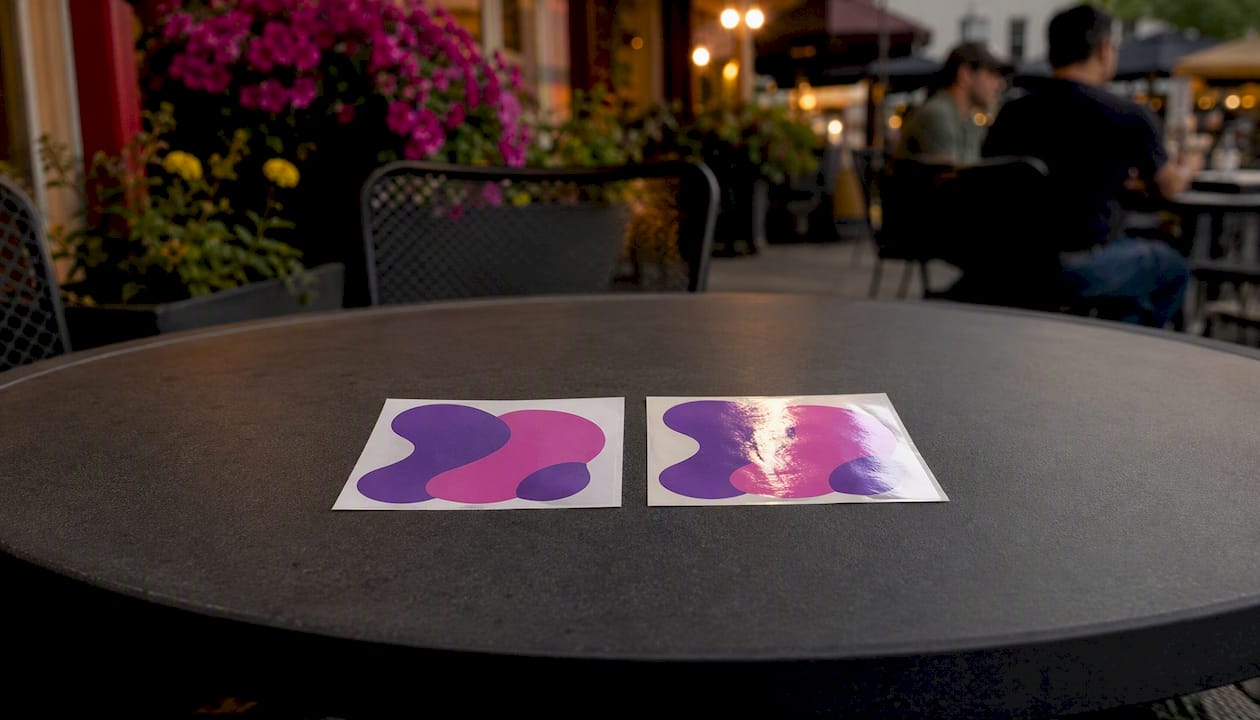
Gloss creates a specular reflection, meaning light bounces off at a predictable angle. Under strong directional lighting — a retail spotlight, a car window in direct sun, or a camera flash — that reflection can completely wash out the design. If your sticker will live in a vehicle interior, under a trade show light, or anywhere a camera will regularly point at it, glare is a real problem worth planning around.
Pro Tip: Before your event or product launch, hold a printed sample under the actual lighting conditions you expect. For event stickers going on name badges or lanyards, check them under the venue’s overhead lights. For product labels, photograph them with your usual product photography setup. A gloss sticker that looks great on a desk can become unreadable under a ring light.
Durability: how each finish holds up to water, UV, and daily wear
Both finishes can be waterproof and weatherproof when printed on quality outdoor vinyl with the right laminate, which chiefly determines longevity. The substrate and laminate specification do most of that work.
That said, there are real differences in how each finish handles specific stressors:
- Water and oils: Glossy surfaces repel moisture and oils more readily, which is why gloss is the standard recommendation for water bottles, exposed packaging, and outdoor signage that sees rain.
- UV fade resistance: Glossy laminates resist UV degradation slightly better in direct sunlight, so colors retain visual intensity longer for outdoor applications.
- Scratch visibility: Matte hides surface scratches better. The diffuse texture masks minor abrasion that would show as a shiny streak on a gloss surface.
- Fingerprints: Matte wins clearly here. Matte hides fingerprints, dust, and minor surface scratches better than gloss, which matters for stickers on products that get handled constantly.
Outdoor lifespan: Die-cut stickers printed on premium vinyl with the correct laminate can last up to five years outdoors. That spec applies to both finishes when the substrate and laminate are right.
The bigger decision for durability is always the substrate. Paper stickers are fine for indoor use and short-term applications. Film is a practical step up for moisture resistance. Vinyl is what you want for anything that will face sun, rain, or repeated handling over months or years.
Pro Tip: When ordering stickers for vehicles, outdoor signage, or long-term product labels, always specify UV-resistant laminate and outdoor-grade vinyl explicitly. “Waterproof sticker” on a supplier’s website doesn’t always mean UV-protected. Ask for both specs in writing before you approve the order.
Can you write on glossy or matte stickers? What you need to know
Matte finishes accept ballpoint and felt-tip pens with less smudging; the slightly textured surface gives ink something to grip. Glossy surfaces are slick, so most pens bead up or smear. A permanent marker (Sharpie is the most reliable) will write on gloss, but it takes longer to dry and is easier to smudge before it sets.
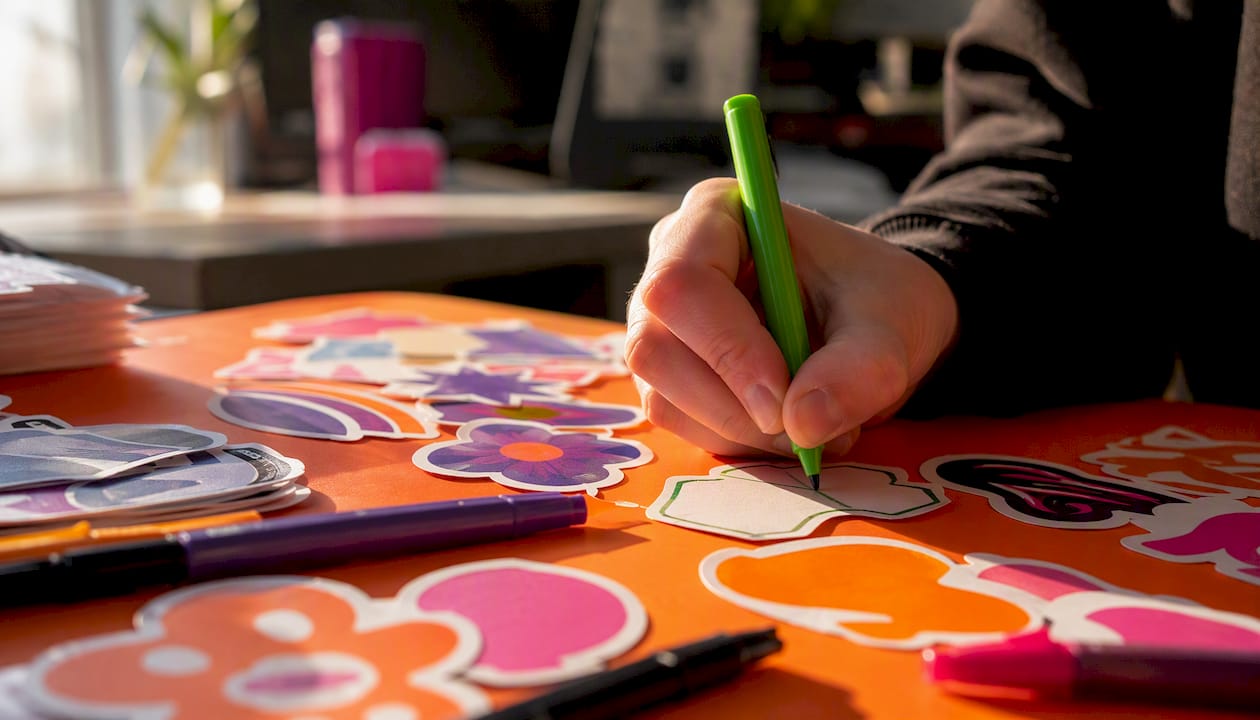
This matters more than people expect. If you’re labeling handmade products with batch numbers, adding names to event stickers, or running a small food or cosmetic business where you hand-write lot codes, matte is the only practical choice. Trying to write on gloss with a standard ballpoint is a frustrating experience.
Pro Tip: Run a quick test before ordering in bulk. Print or order a small sample of your sticker in both finishes, then try a ballpoint pen, a fine-tip felt marker, and a permanent marker on each. Let each mark dry for 30 seconds, then smudge-test with your thumb. The results will tell you everything you need to know about which finish fits your labeling workflow.
Paper, film, and vinyl: how the substrate changes everything
The finish you choose sits on top of a substrate, and that substrate drives durability, adhesion, and cost far more than whether the top coat is matte or gloss. Film labels often provide a practical middle ground between paper and vinyl: more durable than paper for handling and moisture, but not as heavy-duty as vinyl for extreme outdoor exposure.
Here’s how the three main substrates break down:
- Paper: Best for indoor use, short-term labels, and low-cost applications. Not water-resistant without a laminate. Matte paper stickers are common for product labels, packaging inserts, and event materials.
- Film (polypropylene or polyester): A cost-effective middle ground. Handles moisture and handling better than paper, works well for product packaging, cosmetic labels, and food containers. Available in both matte and gloss.
- Vinyl (PVC or cast vinyl): The right choice for outdoor stickers, vehicle decals, gear, and anything that needs to survive years of sun, rain, and temperature swings. Both matte and gloss vinyl can be paired with UV-resistant laminates for maximum longevity.
When you’re ordering stickers for harsh environments, specify the substrate and adhesive first, then choose your finish. A gloss laminate on paper won’t survive a wet water bottle. A matte finish on outdoor vinyl with UV laminate will. The finish is the last decision, not the first.
For buyers exploring different supplier options, resources like print supplier comparisons can help you evaluate what specs different vendors actually include in their base pricing versus what costs extra.
What actually drives sticker cost, and how to order without surprises
Sticker pricing varies more than most buyers expect. The finish itself (matte vs gloss) rarely changes the price significantly. What moves the number is the substrate, laminate type, shape, and quantity.
Key cost drivers:
- Substrate: Vinyl costs more than film, which costs more than paper. The durability premium is real.
- Laminate: A UV-resistant or specialty matte laminate adds cost over a standard gloss coat.
- Shape: Die-cut custom shapes cost more than standard circles, squares, or rectangles because of the cutting setup.
- Quantity: Unit cost drops significantly as quantity increases. A run of 100 stickers costs more per unit than a run of 500 or 1,000.
- Size: Larger stickers use more material. Check the sticker size guide to match your size to your use case before pricing out an order.
Before you approve any order, confirm these four things with your supplier: the substrate material, whether a laminate is included and what type, the expected outdoor lifespan if relevant, and whether a digital proof is included. Red flags on a quote include vague terms like “waterproof coating” with no substrate named, no mention of UV protection for outdoor orders, and no proof step before production.
Pro Tip: Always request a digital proof before production, and if you’re ordering a new design for the first time, consider a small sample run of 10–25 stickers. The cost is low, and it lets you check color accuracy, finish appearance, and adhesion on your actual surface before committing to a full quantity.
How to choose the right finish for your project
Work through these questions in order and you’ll have your answer in under two minutes.
Step 1: Where will the sticker live? Outdoors, on a vehicle, or on a water bottle? Go glossy vinyl with UV laminate. Indoors on a product label or packaging? Either finish works; choose based on brand feel.
Step 2: Do you need to write on it? Yes? Matte only.
Step 3: Will it be photographed regularly? Yes? Matte avoids glare in product shots and social content.
Step 4: What does your brand communicate? Bold, energetic, retail-forward? Gloss. Premium, minimal, or artisan? Matte.
Three common scenarios:
- Water bottle promo sticker: Glossy vinyl. The surface repels moisture and oils, colors stay vibrant, and the finish holds up through repeated washing and handling.
- Luxury product label: Matte film or matte vinyl. The soft texture signals quality, hides fingerprints through handling, and photographs cleanly for e-commerce listings.
- Laptop or event sticker: Matte or gloss depending on the design. Bold, colorful art benefits from gloss; photography or fine-line illustration looks sharper on matte.
Watch for these red flags that should change your spec:
- Harsh outdoor exposure for more than a season? Upgrade to outdoor vinyl with UV laminate regardless of finish.
- Curved or squeezable packaging (like a squeeze bottle)? Specify a flexible film or vinyl with a conformable adhesive.
- Need UV resistance for years? Confirm the laminate spec explicitly. Don’t assume it’s included.
What Shaysprintshop sees customers order and why
Most small businesses ordering through Shaysprintshop fall into a few clear patterns. Event sticker orders, giveaway packs, and merch stickers tend to go glossy. The finish photographs well for social posts, the colors look vibrant in person, and the slick surface feels polished when someone peels and applies it. Product label orders, especially for handmade goods and cosmetic or food products, lean matte. Those customers want a finish that looks intentional and premium, hides handling marks, and accepts handwritten batch codes without smearing.
For outdoor decals and vehicle stickers, the shop’s default recommendation is always glossy outdoor vinyl with UV laminate. The slight edge in UV fade resistance and water beading makes a real difference over months of sun exposure.
Shaysprintshop handles proofs before production on custom orders, which means you see a digital mockup of your design in the chosen finish before anything gets printed. For first-time orders or new designs, a sample run is the most reliable way to check color accuracy and finish appearance on your actual surface. Custom die-cut stickers in both matte and glossy finishes are available in multiple sizes and pack quantities, so you can start small and scale up once the proof looks right.
The finish choice most people overthink
There’s a tendency to treat the matte vs glossy decision as the most important spec on a sticker order. It’s not. Most of the time, the finish that matches your brand’s visual identity is the right one, and the real work is making sure the substrate and laminate are specified correctly for where the sticker will actually live.
What I see trip people up most often is ordering a glossy sticker for a product label and then being surprised when it shows fingerprints after a week on a retail shelf. Or ordering matte for an outdoor decal without specifying outdoor vinyl, and wondering why it fades in a season. The finish is visible. The substrate is invisible. Buyers focus on what they can see and skip the spec that actually matters for durability.
The other thing worth saying: if you genuinely can’t decide, order a small sample of both. View them in the actual environment where they’ll be used. The right answer usually becomes obvious within about 30 seconds of holding both samples under real-world conditions. No amount of reading a comparison guide replaces that.
Shaysprintshop makes it easy to get the right sticker, right the first time
Skip the guesswork on finish, size, and substrate. Shaysprintshop offers custom die-cut stickers in both matte and glossy finishes, available in sizes from 2" to 5" and pack quantities from 10 to 1,000. Upload your design, choose your finish, and get a digital proof before anything goes to print. Need to check color accuracy on your actual product surface? Start with a small sample run and scale up once it looks exactly right.
Bulk pricing drops the unit cost significantly as quantity increases, which makes Shaysprintshop a practical option whether you’re ordering 25 event stickers or 500 product labels. Fast US-based turnaround means you’re not waiting weeks for a reorder. And if you’re also outfitting your team or event with custom apparel, the shop’s custom shirts and apparel collection lets you bundle both in one order. Visit Shaysprintshop to upload your design and get a proof started today.
Sources
These resources were used to compile this guide. Each covers a specific aspect of sticker finish and material selection in more detail.
- Glossy vs Matte Stickers: Finish Guide | Paperlust
- Glossy vs Matte Stickers: How Each Finish Changes Your Design | JukeboxPrint
- Matte Stickers vs. Gloss Stickers: Which is the Right Finish for Your Project? | PrintRunner Blog
- Film, paper, and vinyl labels explained | Avery
- Diecutstickers
- Matte vs Gloss Stickers: Which Finish Should You Choose? - PrintReviewer
Recommended
- Custom Stickers | Die Cut, Circle & Square | Glossy or Matte | 2" | 10 – Shay’s Print Shop
- Custom Stickers | Die Cut, Circle & Square | Glossy or Matte | 5" | 10 – Shay’s Print Shop
- Custom Stickers | Die Cut, Circle & Square | Glossy or Matte | 4" | 10 – Shay’s Print Shop
- Custom Stickers | Die Cut, Circle & Square | Glossy or Matte | 3" | 10 – Shay’s Print Shop
0 comments