

Pick DTG for premium 100% cotton shirts where a soft, embedded feel justifies a higher price point. Pick DTF when you need to print on mixed fabrics, want to pre-produce transfers, or need faster throughput on bulk orders.
Quick guide by goal:
- Single cotton tees, photo prints, or on-demand orders → DTG delivers the softest hand feel and the sharpest gradients on natural fibers.
- Mixed fabrics, polyester, bulk event shirts, or pre-stocked transfers → DTF handles virtually any fabric without per-garment pretreatment.
- Very large runs (100+ identical shirts) → Screen printing may still beat both on per-unit cost once setup fees are spread across the order.
Table of Contents
- How do DTG and DTF compare side by side?
- What is DTG printing and how does it work?
- What is DTF printing and how does it work?
- Print quality and durability: what to expect in practice
- Which fabrics work best with DTG vs DTF?
- Cost, equipment, and turnaround: what the numbers look like
- What specialty finishes can each method produce?
- Environmental impact: water, consumables, and waste
- How to choose: a practical decision checklist
- How Shaysprintshop applies these choices in real orders
- Key Takeaways
- What shops actually do in practice
- Shaysprintshop makes custom cotton shirts simple and affordable
- Sources and further reading
How do DTG and DTF compare side by side?
| Dimension | DTG | DTF |
|---|---|---|
| Fabric compatibility | Best on 100% cotton and natural fibers | Cotton, polyester, blends, nylon, leather |
| Print quality & color vibrancy | Excellent gradients and photo detail on light cotton | Vibrant on darks; strong white ink opacity |
| Hand feel | Soft, embedded in fiber | Surface layer; can feel thicker on large prints |
| Durability / washability | High when properly cured; ink bonds with fiber | High with correct curing; risk of cracking if under-cured |
| Setup & pretreatment | Pretreatment required on dark garments | No per-garment pretreatment; powder adhesive step |
| Per-print consumable cost | Higher (pretreatment fluid adds $0.25–$0.50/shirt; typical total $1.00–$1.50 per dark cotton shirt) | $0.45–$1.10 per shirt for common prints |
| Throughput / turnaround | One shirt at a time; slower on bulk | Assembly-line workflow; transfers pre-produced in advance |
| Specialty finishes | Photo gradients, tonal prints, large-area coverage | Glitter, neon, metallic, faux embroidery, textured transfers |
| Environmental factors | Water-based inks; pretreatment and heat curing waste | No water pretreatment; PET film and adhesive powder as consumables |
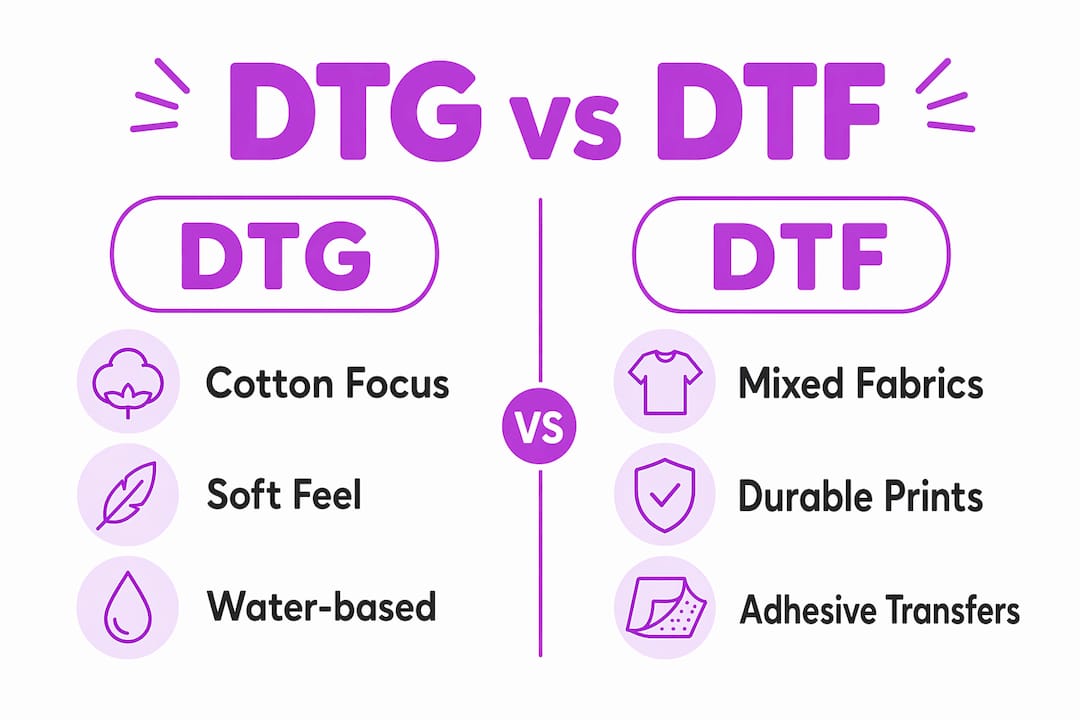
The single most important trade-off: DTG gives you a softer, breathable print that feels like part of the shirt — but only on the right fabric. DTF gives you flexibility across almost any substrate and lets you pre-produce transfers, but the print sits on top of the fabric and can feel slightly thicker on large designs.
What is DTG printing and how does it work?
Direct-to-Garment printing uses a specialized inkjet printer to apply water-based inks directly onto fabric. The ink penetrates the fibers rather than sitting on the surface, which is why DTG-printed shirts feel so natural to wear.
The basic DTG workflow:
- Garment prep — flatten the shirt on the platen; remove wrinkles.
- Pretreatment (dark garments only) — spray or roll pretreatment fluid onto the print area, then heat-press to cure it. This step creates the surface the white underbase needs to bond with.
- White underbase — on dark shirts, the printer lays down a white ink layer first so colors appear vivid rather than muted.
- Color printing — CMYK inks print over the white base (or directly on light shirts).
- Curing — heat tunnel or heat press locks the ink into the fibers.
DTG performs best on 100% cotton and natural fiber blends because the ink absorbs into the fiber structure. Polyester and synthetic fabrics resist absorption, which causes faded or washed-out results. For photo-quality and large-area prints, DTG’s ink penetration produces gradients that transfer methods struggle to match.
Pro Tip: Calibrate your pretreatment volume per fabric weight. Too little and the white underbase won’t adhere; too much and you’ll see a visible residue halo around the print. Run a test strip on each new garment style before committing to a full run.
What is DTF printing and how does it work?
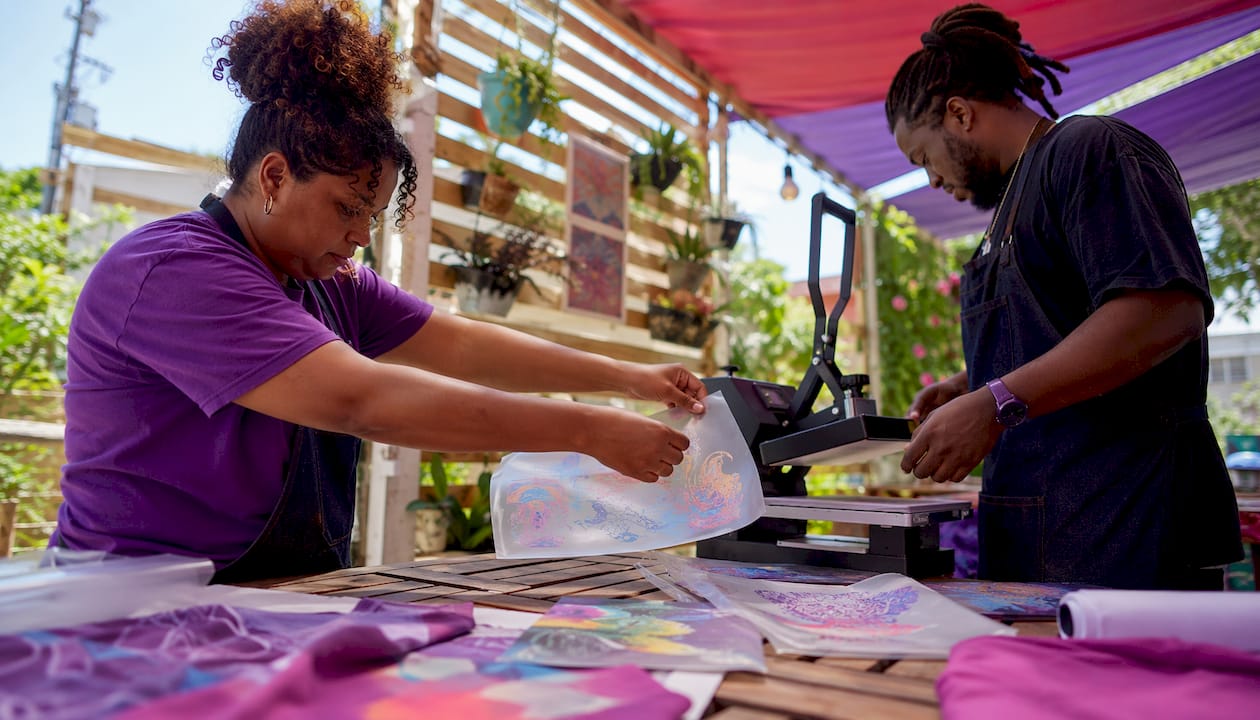
Direct-to-Film printing separates the print step from the garment entirely. You print onto a clear PET film, apply adhesive powder, cure the transfer, and then heat-press it onto whatever substrate you need. Because the transfer is made independently of the garment, DTF adheres to cotton, polyester, blends, nylon, and leather without any per-garment pretreatment.
The DTF workflow:
- Print to film — print the design (including a white underbase layer) onto PET transfer film.
- Apply adhesive powder — hot-melt powder is applied while the ink is still wet, coating the printed area.
- Cure — the film passes through a dryer or oven, melting the powder into a smooth adhesive layer.
- Heat-press transfer — the cured film is placed on the garment and pressed at the correct temperature and pressure.
- Peel — hot peel (immediately after pressing) or cold peel (after cooling) depending on the transfer type.
Hot peel vs cold peel: Hot-peel transfers release the film right after pressing and speed up production. Cold-peel transfers require the garment to cool first but often produce a slightly smoother finish. Most shops choose based on throughput needs and the specific film they stock.
One of DTF’s biggest operational advantages: transfers can be printed, cured, and stored as inventory before the garment even arrives. That means you can react to a spike in orders without waiting for a full print run.
Pro Tip: Use lightweight adhesive powder and dial in your curing temperature carefully. Most complaints about a stiff or “crunchy” DTF feel come from over-application of powder or under-curing, not from the technology itself.
Print quality and durability: what to expect in practice
Color vibrancy on dark garments is where the two methods diverge most visibly. DTF lays down a white underbase as part of the film print, so colors pop on black or navy shirts without the pretreatment step DTG requires. DTG can match that vibrancy, but only when pretreatment is applied correctly and the white underbase is calibrated to the specific fabric.
Hand feel is the other big differentiator. DTG’s ink penetrates the fibers, producing a soft, breathable result that feels like part of the shirt. DTF sits on the surface. For small logos or chest prints, the difference is barely noticeable. On a full-back design, a DTF transfer can feel noticeably thicker, especially if the powder was over-applied.
Common failure modes to watch for:
- DTG cracking — usually caused by under-curing or printing on a fabric with too high a polyester content.
- DTG halo effect — excess pretreatment fluid visible around the print area; fix by reducing pretreatment volume.
- DTF peeling or lifting — typically from insufficient heat-press pressure, wrong temperature, or an incompatible fabric coating.
- DTF stiffness — over-application of adhesive powder; switch to a lighter powder grade and recheck curing time.
Pro Tip: Before scaling any new workflow, wash five test shirts at least three times using a standard warm-water cycle. Check for cracking, color shift, and edge lifting. This catches calibration issues before they reach a customer’s order.
Which fabrics work best with DTG vs DTF?
The fabric question is often the deciding factor before anything else.
DTG works best on:
- 100% cotton (ringspun, combed, or standard)
- Cotton-linen blends
- Canvas, denim, and hemp
- Natural fiber tote bags and hoodies
Cotton’s fiber structure absorbs water-based ink, which is why DTG prints on 100% cotton shirts feel so soft and last through repeated washing. Blends above 50% polyester produce noticeably duller results because the synthetic fibers resist ink absorption.
DTF handles a much wider range:
- Polyester and performance fabrics
- Cotton-polyester blends at any ratio
- Nylon and spandex
- Leather and faux leather
- Hats, bags, and hard-to-reach curved surfaces
DTF’s adhesive transfer bonds to almost any surface, which makes it the go-to for sportswear, team uniforms, and mixed-fabric retail orders. If your customer brings in a moisture-wicking polo or a nylon jacket, DTF is the practical answer.
Pretreatment labor cost for DTG: Pretreating a dark garment adds roughly 2–3 minutes of handling time per shirt and costs an additional $0.25–$0.50 per garment in fluid. On a 50-shirt dark-garment run, that adds up to meaningful labor and consumable cost before a single shirt is printed.
Cost, equipment, and turnaround: what the numbers look like
Per-shirt consumable costs depend on design size, garment color, and volume. Costs vary widely based on many factors and should be considered illustrative rather than precise.
DTG’s higher dark-garment cost comes from pretreatment fluid and increased white-ink consumption. DTF’s cost advantage grows at volume because transfers can be produced in an assembly-line workflow using roll-fed printers and curing lines, rather than printing one shirt at a time.
Equipment considerations:
- Entry-level DTG printers start around $15,000–$20,000; production models run significantly higher.
- DTF setups (printer plus powder shaker and curing unit) can start lower, but the powder-shaker and curing module add both cost and maintenance complexity.
- Both technologies require white-ink maintenance as a recurring operational task. Newcomers consistently underestimate this when budgeting total cost of ownership.
For most small shops and event-focused sellers, outsourcing to a print partner is more practical than owning equipment until volume justifies the capital investment.
What specialty finishes can each method produce?
DTF opens up a range of decorative effects that DTG simply cannot replicate.
DTF specialty finishes:
- Glitter and holographic transfers
- Neon and fluorescent effects
- Metallic and foil-style prints
- Textured transfers that mimic embroidery (faux embroidery saw notable growth in popularity recently, per Mimaki’s market observations)
- Puff and 3D-effect transfers
DTG strengths for effects:
- Photo-realistic gradients and tonal prints
- Fine-detail artwork with subtle shading
- Large-area full-coverage prints on cotton where ink absorption produces smooth color transitions
One practical limit for DTF: very large full-back transfers can feel noticeably heavier and less breathable than a DTG print of the same size. If a premium, barely-there feel matters to your customer, DTG on cotton is still the better route for large designs.
Environmental impact: water, consumables, and waste
Neither method is perfectly clean, but the trade-offs are different.
DTG environmental profile:
- Uses water-based inks, which are generally lower in volatile organic compounds than plastisol.
- Pretreatment fluid requires careful disposal; some formulations contain compounds that need proper handling.
- Heat curing consumes energy, though tunnel dryers are not always required for small setups.
- No plastic film waste per garment.
DTF environmental profile:
- Eliminates the water-intensive pretreatment step, reducing water use per garment.
- PET transfer film and adhesive powder are consumables that generate plastic waste. Recycling options for used DTF film are limited in most U.S. markets.
- Roll-fed production can reduce material waste compared to sheet-fed setups.
Which workflow is greener depends on your scale and local recycling infrastructure. At low volumes, DTG’s water-based ink and no-film approach has a lighter footprint. At high volumes, DTF’s elimination of water pretreatment and its efficient roll-fed production can offset the plastic consumable waste, particularly if your local facility has film recycling access.
How to choose: a practical decision checklist
Work through these questions before committing to a method or vendor.
Match your business model to the method:
- Are most of your orders 100% cotton? → DTG is likely your primary method.
- Do you print on polyester, blends, or performance fabrics regularly? → DTF is the practical choice.
- Do you need to pre-produce transfers or build inventory before orders arrive? → DTF only.
- Is a soft, breathable hand feel a selling point for your price tier? → DTG on cotton.
- Are you running bulk event orders (50+ shirts, same design)? → DTF’s assembly-line workflow wins on throughput.
Questions to ask equipment sellers or print vendors:
- What is your white-ink maintenance schedule and what does it cost annually?
- What transfer peel type do you use (hot or cold), and can I request samples?
- Do you offer wash-test samples before I commit to a bulk order?
- What is your minimum order quantity, and does pricing change at 10, 25, or 50 units?
Red flags during vendor evaluation:
- No sample wash-test offered before a bulk order.
- Vague answers about pretreatment process or white-ink management.
- Inability to show prints on the specific fabric you plan to use.
- No clear answer on curing temperature or press time for their DTF transfers.
For a quick shortcut, browse Shaysprintshop’s custom apparel options to see how a shop that handles both methods structures its offerings.
How Shaysprintshop applies these choices in real orders
Shaysprintshop specializes in 100% cotton custom t-shirts, which puts the shop squarely in DTG-friendly territory for most orders. Cotton’s fiber absorption makes it the ideal substrate for vibrant, soft prints that hold up through repeated washing.
A typical event tee order at Shaysprintshop:
- Substrate: 100% cotton t-shirt
- Method: DTF on cotton for bulk event orders, delivering consistent color across the run
- Price band: 10 shirts for $99, making per-shirt cost straightforward for event planners and group organizers
- Turnaround: Fast, with the ability to handle large orders efficiently
| Order type | Recommended method | Typical price band |
|---|---|---|
| 10 cotton event tees, single design | DTF | $99 for 10 shirts |
| Single custom cotton tee | DTG or DTF | Per-shirt pricing |
| Mixed-fabric or specialty garment | DTF | Quote-based |
| Tote bags, promotional items | DTF | Quote-based |
Shaysprintshop also prints custom tote bags and other promotional items, where DTF’s substrate flexibility handles materials that DTG cannot.
When Shaysprintshop recommends each method:
- Cotton tees in bulk for events, reunions, or businesses → DTF for throughput and consistent color.
- Single-piece or photo-quality cotton prints → DTG for the softest feel and finest detail.
- Mixed-fabric or non-cotton items → DTF every time.
Pro Tip: If you’re ordering event shirts for a Florida reunion or business gathering, order a sample shirt first. Seeing the actual print and feeling the hand feel on your specific shirt color tells you more than any spec sheet.
Key Takeaways
DTF is the more flexible method for mixed-fabric and bulk production, while DTG remains the best choice for premium soft-feel prints on 100% cotton.
| Point | Details |
|---|---|
| Fabric drives the decision | DTG excels on 100% cotton; DTF works on cotton, polyester, blends, nylon, and leather. |
| Hand feel matters for pricing | DTG’s embedded ink feels softer; DTF sits on the surface and can feel thicker on large designs. |
| Cost scales differently | DTF consumables cost varies; DTG dark-garment costs rise with pretreatment fluid. |
| Bulk orders favor DTF | DTF’s assembly-line workflow and pre-producible transfers outpace one-at-a-time DTG on volume. |
| Shaysprintshop’s sweet spot | 100% cotton event tees at 10 for $99, with fast turnaround for events, businesses, and reunions. |
What shops actually do in practice
Most print shops that have been running for a few years end up with a hybrid workflow, even if they started with just one method. The pattern is consistent: DTG handles the premium cotton orders where customers are paying for that soft, retail-quality feel, and DTF covers everything else, including the mixed-fabric jobs, the last-minute bulk runs, and the pre-produced transfers sitting ready for a spike in demand.
The shops that struggle are usually the ones that try to force one method onto every job. DTG on a 65/35 poly-cotton blend produces a dull, faded print that damages customer trust fast. DTF on a single premium photo tee where the customer specifically wants a soft feel is a mismatch that shows up the moment they put the shirt on.
The smartest operational move for a new shop is to pilot test both methods on your actual product mix before investing in equipment. Run 10 shirts through each workflow, wash them five times, and compare. That test costs almost nothing compared to the cost of scaling the wrong process. Protect your margin during any process change by keeping a small buffer in your pricing until you’ve confirmed your consumable costs and rejection rate on the new workflow.
Shaysprintshop makes custom cotton shirts simple and affordable
Custom cotton shirts for your event, business, or group don’t have to be complicated. Shaysprintshop delivers 10 custom 100% cotton t-shirts for $99, with fast turnaround and no guesswork on pricing. You upload your design, pick your colors and sizes, and the shop handles the rest.
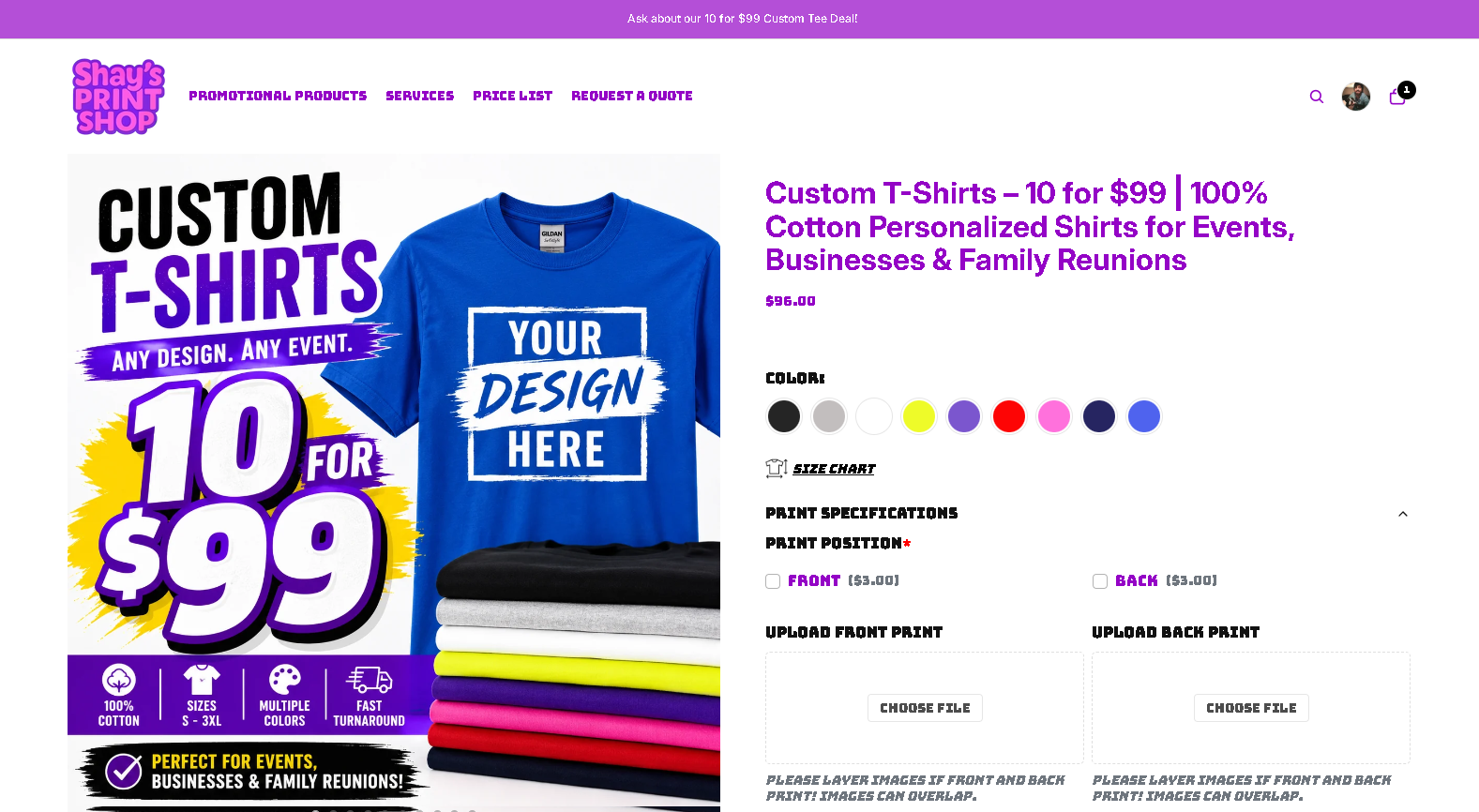
For cotton event tees, Shaysprintshop uses DTF for bulk orders to keep colors consistent and turnaround fast. For single-piece or photo-quality prints, DTG delivers the softest feel on 100% cotton. Either way, you get durable, comfortable shirts that hold up through the event and beyond. The shop also handles custom tote bags, mugs, hats, and other personalized items for a complete event package.
Ready to place your order or need a quote for a larger run? Request a quote and get a fast response from the Shaysprintshop team.
Sources and further reading
Technical explainers:
- DTF vs DTG Printing: The Technologies Shaping Today’s Custom Merchandise Market — Mimaki Europe’s overview of both technologies, workflow differences, and hybrid adoption trends.
- The Pros and Cons of Direct-to-Film and Direct-to-Garment Printing — FESPA’s balanced breakdown of pretreatment, white-ink management, and maintenance considerations.
Cost and process guides:
- DTF Printing: The Complete Guide to Direct-to-Film Transfers — Detailed consumable cost data, per-shirt pricing examples, and workflow guidance.
- DTG vs. DTF Printing: How to Choose for Your Business — Shopify’s practical guide covering throughput, business model fit, and assembly-line production.
Industry summaries:
- What Is DTG Printing? Direct-to-Garment Printing Tips — Shopify’s accessible overview of DTG workflow, fabric suitability, and comparison with other methods.
- DTG Printer Guide: How Direct-to-Garment Printing Works — Covers photographic print quality, gradient performance, and equipment selection considerations.
Recommended
- (Daisy) Custom T-Shirts – 10 for $99 | 100% Cotton Personalized Shirts – Shay’s Print Shop
- Custom T-Shirts – 10 for $99 | 100% Cotton Personalized Shirts for Eve – Shay’s Print Shop
- (Heather Grey) Custom T-Shirts – 10 for $99 | 100% Cotton Personalized – Shay’s Print Shop
- Custom 100% Cotton T-Shirt – Shay’s Print Shop
0 comments