

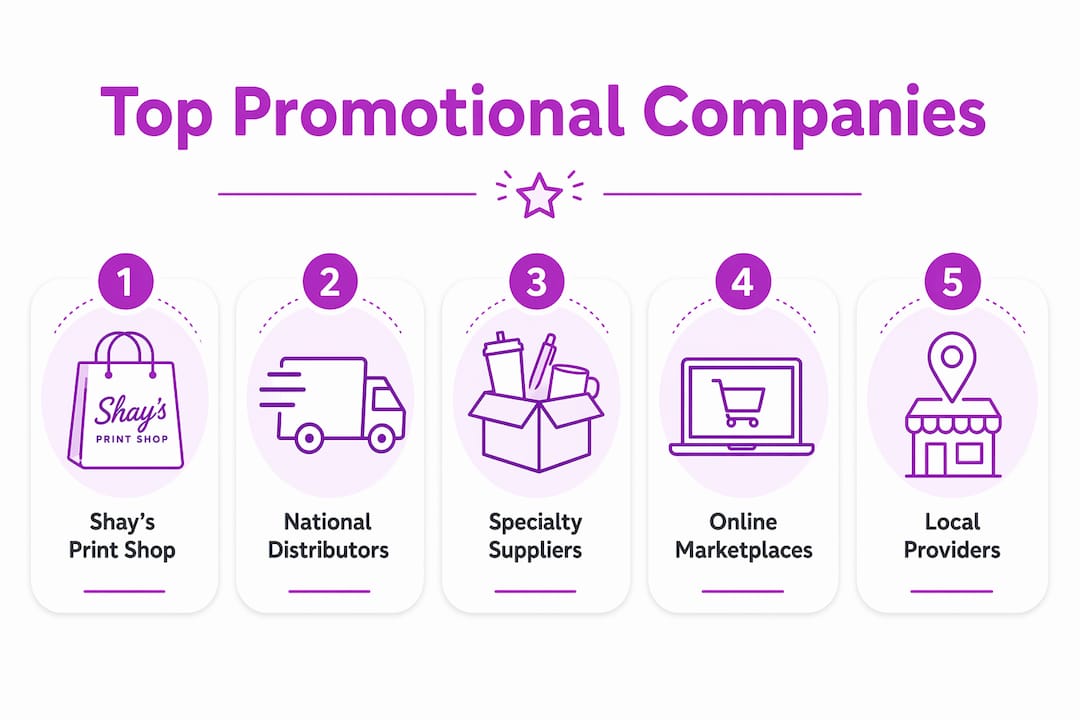
The best promotional product companies for most buyers in 2026 are Shay’s Print Shop (best for small-to-medium bulk custom apparel in Massachusetts), large national distributors (best for enterprise-scale giveaways), full-service apparel specialists (best for decoration-heavy garment programs), print-on-demand marketplaces (best for no-minimum personalization), and corporate swag program managers (best for recurring employee gifting). The promotional products sector generated $25.5 billion in 2022, and the range of supplier types has never been wider — which makes choosing the right partner genuinely harder than it looks.
Here is the quick shortlist:
- Shay’s Print Shop — 10 shirts for $99, 100% cotton, DTF printing, US-based fulfillment, low minimums. Best for events, families, and small businesses in Massachusetts.
- Large national distributors (4imprint, HALO Branded Solutions, Geiger, Proforma) — broad catalogs, national warehousing, account managers. Best for high-volume corporate programs.
- Full-service apparel specialists (Custom Ink, ShopELITE Promo) — apparel-first production, multiple decoration methods, strong size/color depth. Best for garment-focused campaigns.
- Print-on-demand marketplaces — no minimums, webstore integrations, flexible personalization. Best for one-off gifts or low-volume retail merch.
- Corporate swag program managers (ePromos, Proforma) — automated distribution, API integrations, program reporting. Best for enterprise employee gifting.
- Sustainable/eco-focused suppliers — PPAI 100 rankings now weight sustainability explicitly; ask any shortlisted supplier for their eco certifications before committing.
Table of Contents
- How we evaluated the best promotional product companies
- Side-by-side comparison of top options
- Which company is right for your situation?
- How to choose a promotional products company
- What are the most popular promotional products?
- Why Shaysprintshop is our pick for custom apparel and small bulk orders
- Key Takeaways
- What buyers actually value when choosing a supplier
- Your next order starts here
- Useful sources and references
How we evaluated the best promotional product companies
Every company and category on this list was assessed against nine criteria drawn from the PPAI 100 scoring framework, which ranks leading distributors across growth, digital transformation, sustainability, employee development, and volunteerism. Here is how the weighting breaks down:
- Program services and account management — webstores, program centers, automated distribution, and API capabilities
- Pricing transparency and bulk discounts — published pricing, volume tiers, and sample costs
- Minimum order quantity (MOQ) — how low a supplier will go without a surcharge
- Product range — apparel, drinkware, tech, bags, stationery, and specialty items
- Customization methods — screen print, embroidery, DTF, laser engraving, full-color imprint
- Lead times and rush options — standard production windows and next-day qualifying products
- Sample policy — whether samples are free, charged, or credited against an order
- Sustainability and eco options — recycled materials, eco certifications, and supplier transparency
- US-based fulfillment footprint — domestic warehousing and distribution reach
Data came from supplier service pages, PCNA’s program center documentation, the Forbes Advisor promotional products roundup, PPAI 100 published rankings, and direct review of published pricing packages. Where pricing was not publicly listed, we noted it as such rather than guessing.
Pro Tip: Ask every supplier you shortlist for their PPAI membership number or equivalent industry affiliation. PPAI members agree to a code of conduct that covers product safety and ethical sourcing — it is a fast filter for reliability.
Side-by-side comparison of top options
The table below covers the primary buying dimensions. Shay’s Print Shop leads as the featured option; provider categories follow in order of typical buyer fit.
| Provider | Best for | Pricing & bulk discounts | MOQ | Product range | Customization methods | Lead time / rush | Sample policy | Sustainability | Account mgmt / programs | US fulfillment |
|---|---|---|---|---|---|---|---|---|---|---|
| Shay’s Print Shop | Small-to-mid bulk event apparel, families, small businesses | 10 shirts for $99; transparent bulk tiers | 10 units | Custom apparel, tote bags, mugs, stickers, hats, tumblers | DTF, full-color imprint | Fast turnaround; quote-based rush | Quote-based | US-based production | Direct quote flow; online ordering | Yes — US-based |
| Large national distributors | Enterprise programs, high-volume giveaways | Volume discounts; negotiated pricing | Varies (often 24–144+) | Apparel, drinkware, tech, bags, pens, specialty | Screen print, embroidery, laser, full-color | 5–10 business days; next-day on qualifying items | Varies by supplier | Growing eco lines | Program centers, webstores, account managers | Extensive national |
| Full-service apparel specialists | Garment-quality campaigns, multi-method decoration | Mid-range; quantity breaks | Typically 6–24 | Apparel-focused; some accessories | Screen print, embroidery, DTF, heat transfer | 7 days; rush available | Sample packs available | Varies | Online design tools; rep support | Regional to national |
| Print-on-demand marketplaces | One-off gifts, low-volume retail, webstore merch | Per-unit pricing; no bulk discount | 1 unit | Apparel, accessories, home goods | DTF, sublimation, direct-to-garment | 3–7 days | No samples needed | Some eco options | Webstore integrations | Distributed fulfillment |
| Corporate swag program managers | Employee gifting, multi-location distribution, recurring programs | Program pricing; annual contracts | Program-level | Broad: apparel, tech, branded gifts | Multiple methods via partner network | Program-scheduled | Program samples | Eco program options | API integrations, automated distribution, reporting | National |
Pricing callouts:
- Shay’s Print Shop: 10 shirts for $99 — one of the clearest per-unit prices you will find at this MOQ level.
- Large national distributors: per-unit costs drop significantly at 144+ units, but setup fees and minimums apply.
- Print-on-demand: no minimums, but per-unit cost is higher than bulk. Print-on-demand suppliers like those in the Polyconcept network trade lower per-unit discounts for maximum flexibility.
Which company is right for your situation?
Matching your use case to the right supplier type saves time and money. Here is where each category wins.
- Bulk event giveaways (50–500 units): Shay’s Print Shop handles this range well, with transparent pricing and fast US-based fulfillment. Request a quote with your event date and quantity — turnaround expectations are confirmed at that stage. For orders above 500 units with complex logistics, a large national distributor with a dedicated account manager is the better fit.
- Trade show swag: Large national distributors and full-service apparel specialists are strong here. They carry the broadest product catalogs (pens, drinkware, tech items, tote bags) and can coordinate multi-SKU shipments to a convention center. Ask for a shipping-run quote and confirm the delivery address policy for trade show venues.
- Employee gifting programs: Corporate swag program managers are built for this. Program centers and automated distribution remove the administrative burden of recurring sends, and webstore integrations let employees self-select within a curated catalog. Request a program center demo before signing any annual contract.
- Small-batch custom apparel for events or families: This is where Shay’s Print Shop is the clearest choice. Ten shirts for $99 with DTF printing means your family reunion, team event, or nonprofit fundraiser gets professional-quality shirts without a large upfront commitment.
- Sustainable/eco-focused campaigns: PPAI now weights sustainability explicitly in its supplier rankings. Ask any shortlisted supplier for specific eco certifications (recycled materials, organic cotton, carbon-offset shipping) rather than accepting vague “green” claims. Some large national distributors and corporate program managers have dedicated eco product lines.
- Retail or POP branded merchandise: Print-on-demand marketplaces are the practical choice here. No minimums and webstore integrations mean you can test product designs without committing to inventory.
Pro Tip: For any use case involving branded merch that people will actually keep and use, focus on utility and perceived value over price per unit. A well-made tote bag or quality cotton shirt gets worn repeatedly — that is repeated brand exposure at no extra cost. Check out event merchandise ideas for inspiration on items that resonate beyond the event itself.
How to choose a promotional products company
Before you sign a purchase order or submit a design file, run through these questions with every supplier you are considering.
- What is your standard lead time, and what qualifies for rush production? Many suppliers advertise next-day turns on qualifying products, but sample and proof policies differ significantly. Get the answer in writing.
- What is your minimum order quantity, and does it vary by product type? A supplier with a 144-unit minimum on drinkware may have a 24-unit minimum on apparel. Confirm per-product.
- Which customization methods do you offer, and are there setup fees? Screen print, embroidery, DTF, laser engraving, and full-color imprint each have different cost structures. Setup fees can add $25–$75 per color or location.
- What is your sample policy? Free samples, charged samples, and credited samples are all common. No sample policy at all is a red flag.
- How do you handle quality issues or reprints? A supplier with no published quality or returns policy is a risk, especially on large orders.
- Do you have US-based warehousing and fulfillment? If you need fast domestic shipping or multi-location distribution, confirm the fulfillment footprint before ordering.
- Are you a PPAI member or affiliated with an industry body? PPAI membership signals a baseline commitment to product safety and ethical sourcing.
Red flags to watch for:
- No published sample policy or proof process
- Opaque pricing with no published tiers or example quotes
- No US-based fulfillment when you need domestic delivery speed
- Inability to provide references or on-time fulfillment metrics
- Vague sustainability claims with no certifications to back them
Pricing expectations vary by product type. Apparel (t-shirts, hoodies) typically runs $5–$20 per unit at moderate quantities, with per-unit cost dropping as quantity rises. Drinkware (mugs, tumblers, water bottles) sits in a similar range. Tech items like power banks and wireless chargers carry higher per-unit costs and often higher minimums. The single biggest lever on per-unit price is quantity: doubling your order size usually cuts per-unit cost by 20–40%, depending on the supplier and imprint method.
What are the most popular promotional products?
Certain product categories consistently outperform others in terms of recipient retention and brand recall. Here is where buyers typically spend their budgets and why.
| Category | Why it works | Typical imprint methods | Budget tier |
|---|---|---|---|
| T-shirts / apparel | High perceived value, worn repeatedly, strong brand visibility | Screen print, DTF, embroidery | Mid ($5–$20/unit at volume) |
| Drinkware (mugs, tumblers, water bottles) | Daily use, long product life, high imprint area | Laser engraving, full-color wrap, sublimation | Mid ($6–$20/unit) |
| Tote bags | Practical, eco-friendly perception, large imprint area | Screen print, full-color | Low-mid ($3–$10/unit) |
| Pens / writing instruments | Lowest cost per impression, mass giveaway staple | Pad print, laser | Low ($0.50–$3/unit) |
| Mugs | Office staple, high daily exposure | Full-color wrap, sublimation | Low-mid ($5–$12/unit) |
| Tech items (power banks, wireless chargers) | High perceived value, premium gifting | Laser engraving, full-color | Premium ($15–$40/unit) |
| Notebooks / planners | Long use cycle, professional feel | Debossing, full-color cover | Mid ($5–$20/unit) |
- Apparel is the category with the highest repeat-exposure value. A quality cotton shirt worn to the gym or a weekend errand runs your brand in front of new people every time.
- Drinkware has a long product life and sits on desks and in kitchens daily. Laser-engraved tumblers and full-color mugs both hold up well over time.
- Tote bags carry an eco-friendly perception that resonates with sustainability-focused campaigns. Screen-printed canvas totes are among the most cost-effective options per impression.
- Tech items work best as premium gifts for clients or top-tier event attendees. The higher per-unit cost is justified when the audience and occasion warrant it.
- Pens remain the highest-volume giveaway item at trade shows because the cost per unit is low enough to hand out freely. Imprint longevity on pad-printed pens is shorter than on laser-engraved items, so factor that in for longer campaigns.
For non-apparel items like custom coffee mugs, Shaysprintshop offers 12 personalized 11oz mugs for $75 — a concrete pricing example for buyers comparing product types.
Why Shaysprintshop is our pick for custom apparel and small bulk orders
For event planners, small businesses, families, and nonprofits in Massachusetts who need custom shirts without a large minimum or a complicated quoting process, Shaysprintshop is the clearest starting point on this list.
Here is what makes it work for this buyer:
- 100% cotton t-shirts with DTF printing — DTF (direct-to-film) produces full-color, durable prints that hold up through repeated washing, which matters for event shirts people actually wear again.
- 10 shirts for $99 — that is $9.90 per shirt, a price point that competes directly with national suppliers at much higher minimums.
- Low MOQ — you do not need to order 144 units to get a reasonable per-unit price. Ten units is the entry point.
- US-based fulfillment — orders ship domestically, which keeps lead times predictable and avoids international shipping delays.
- Simple quote flow — upload your design, pick your colors and sizes, and request a quote. No account setup, no sales rep gatekeeping.
A practical example: a community nonprofit planning a 100-person fundraiser walk needs shirts for volunteers and participants. At Shaysprintshop’s bulk pricing, 100 shirts is a straightforward order with a clear per-unit cost, DTF printing for a full-color logo, and fast turnaround. The organizer uploads the design, confirms sizes, and gets a quote without navigating a complex program portal.
Pro Tip: If you are ordering for an event with a hard date, mention it in your quote request. Shaysprintshop’s turnaround is built for exactly this scenario — giving you a realistic production window so you are not scrambling the week before.
Key Takeaways
Shaysprintshop is the strongest choice for small-to-medium bulk custom apparel in Massachusetts, while large national distributors and corporate program managers serve enterprise-scale needs that require complex logistics and recurring fulfillment.
| Point | Details |
|---|---|
| Top pick for small bulk orders | Shaysprintshop offers 10 shirts for $99 with DTF printing and US-based fulfillment — low MOQ, transparent pricing. |
| Match supplier type to use case | Event apparel fits local/small specialists; enterprise programs need national distributors with program centers. |
| Three red flags to avoid | No sample policy, opaque pricing, and no US-based fulfillment are the top warning signs before committing. |
| Ask lead time first | Confirm standard and rush production windows in writing before submitting a design — policies vary widely. |
| Shaysprintshop for Massachusetts buyers | For events, families, and small businesses, Shaysprintshop’s bulk packages and fast turnaround are the practical starting point. |
What buyers actually value when choosing a supplier
The conventional wisdom in promotional products is to lead with price per unit. That framing misses what actually goes wrong on orders. The problems buyers remember are not the ones where they paid $0.50 more per shirt. They are the ones where the order arrived three days after the event, the colors were off, or the supplier had no process for handling a reprint.
On-time fulfillment, honest pricing with no hidden setup fees, and a clear sample or proof policy are the three things that separate a supplier worth returning to from one you use once and regret. Sustainability and digital program capabilities matter too, and PPAI data confirms that leading suppliers now treat these as core differentiators rather than optional extras.
For medium and large programs, program services and webstores often deliver more value than the lowest per-item price. Removing the administrative friction of recurring orders is worth a few cents per unit when you are running a quarterly employee gifting program across multiple locations.
Shaysprintshop is the publisher of this article. That said, the recommendation stands on its merits: for small-to-medium bulk custom apparel with a clear price and fast US-based fulfillment, it is the most practical option for Massachusetts buyers on this list.
Your next order starts here
Shaysprintshop gives you a concrete alternative to navigating large national distributors when your need is straightforward: custom shirts, a real deadline, and a price you can plan around. Ten shirts for $99 in 100% cotton with DTF printing, shipped from the US, with a simple quote process that does not require a sales call.
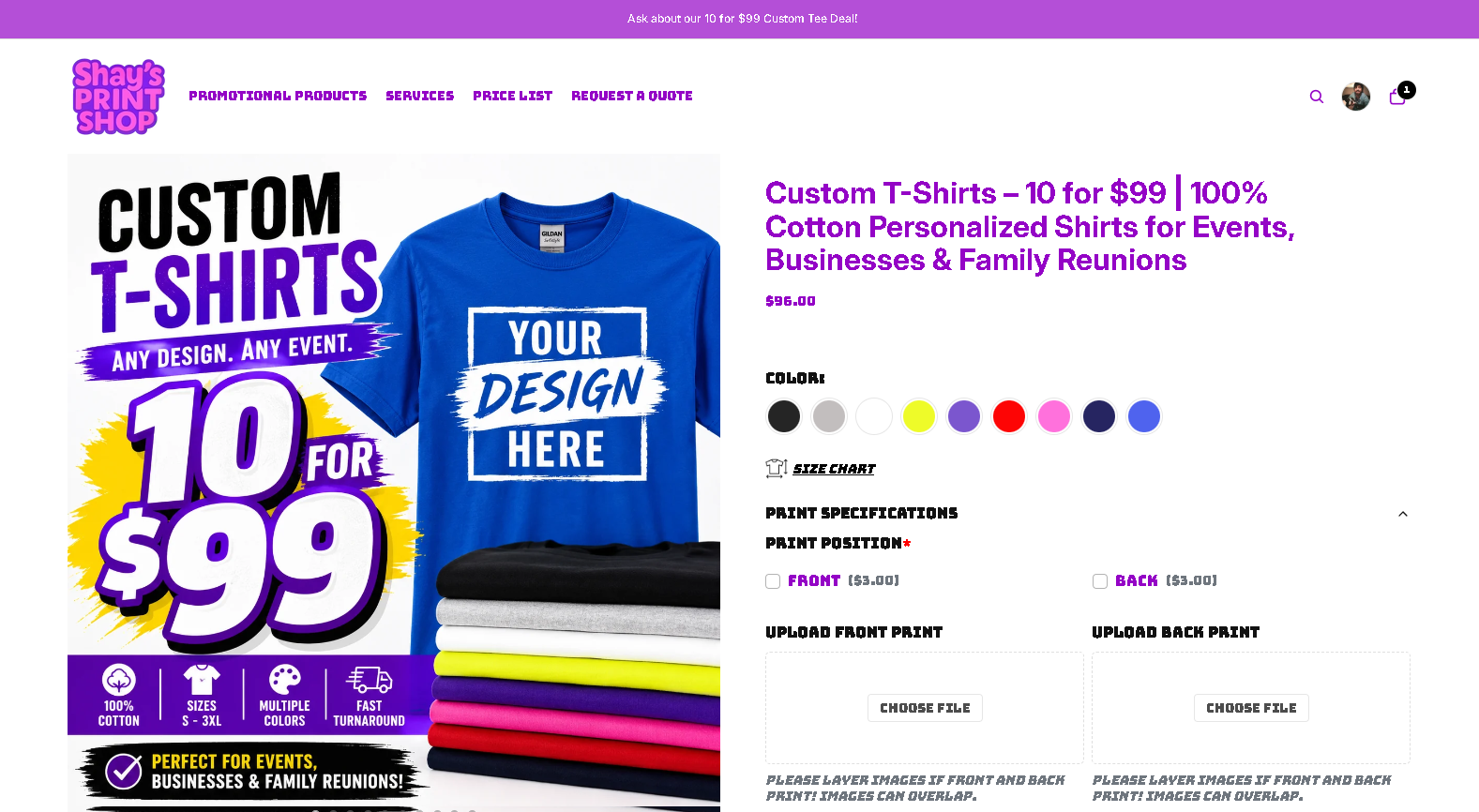
If you are planning an event, outfitting a team, or putting together branded merch for your small business, the fastest path is to request a quote with your quantity, design, and event date. You can also browse the full custom shirts and apparel collection to see color and size options before committing. Turnaround expectations are confirmed at the quote stage, so you will know exactly where you stand before placing an order. For branded merch that people genuinely want to keep, quality and utility matter as much as price — branded merch that resonates is the kind that gets worn, used, and seen long after the event ends.
Useful sources and references
The following resources informed the evaluation criteria, candidate selection, and pricing context in this article.
- PPAI 100 — The Promotional Products Association International’s annual ranking of leading distributors and suppliers. Used for scoring criteria (growth, sustainability, digital transformation, employee development, volunteerism) and as a benchmark for industry trust signals.
- Forbes Advisor promotional products roundup — Curated list of top suppliers with notes on audience fit and order-size focus. Used for sector size data ($25.5 billion in 2022 sales) and third-party candidate validation.
- PCNA program center and services — Supplier service documentation covering program centers, webstores, automated distribution, API integrations, and Sureship next-day turn options. Used for the account management and lead time columns in the comparison table and for buying-guide guidance on program services.
- Polyconcept distributor overview — Global distributor profile covering print-on-demand operations (Spoke Custom, T Shirt & Sons) and low-MOQ fulfillment capabilities. Used for the print-on-demand marketplace category description and MOQ context.
- Shaysprintshop — 10 for $99 custom t-shirts — Publisher’s own product page confirming pricing, cotton specification, DTF printing method, and US-based fulfillment. Used for the EEAT spotlight section and comparison table pricing row.
0 comments